Fighting a clamdemic: A golden mussel FAQ

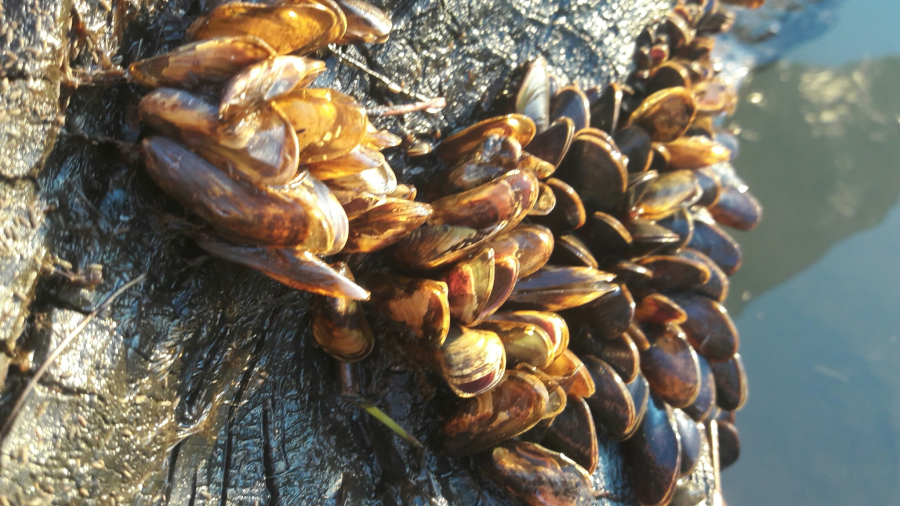
Source: CDWR on Facebook. I thought about titling this post “Violence of the Clams” until I realized American Dad beat me to it, releasing an episode with that title in 2024

I legitimately admire clams. I whole-gilledly believe that they do a lot of good for the world; way more than we do! But there’s no doubt that some types of clams are up to no good, thanks to our help. One of those species is Limnoperna fortunei, the golden mussel. In late 2024, this species was observed for the first time on the North American continent, found attached to various human infrastructure in the Sacramento Delta of California. Since then, it has made its way down the California aqueduct all the way to the Southern tip of the Central Valley. Golden mussels are a notorious invasive species, and California officials immediately recognized the potential for disaster here, leading to dramatic policies of containment throughout the state that have tremendously impacted the lives of people trying to enjoy life on the water.
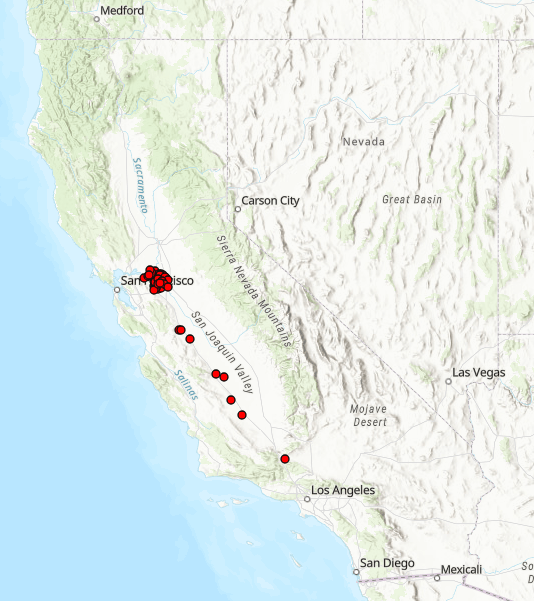
Map from CDFW showing the locations golden mussels have been observed as of July 2025

Since we are in uncharted waters with these mussels, there are a lot of questions about these innocuous-looking but trouble-making clams. In this blog, I will try to answer some of the most frequent questions I’ve seen over the last few weeks. I will caveat this by saying that I currently have no active research on this species, but I am a card-carrying clam scientist, and have a lot of interest in its biology and the significance its presence it will have for our state. So let’s get into it!

What are golden mussels? Where are they originally from? How did they get here?
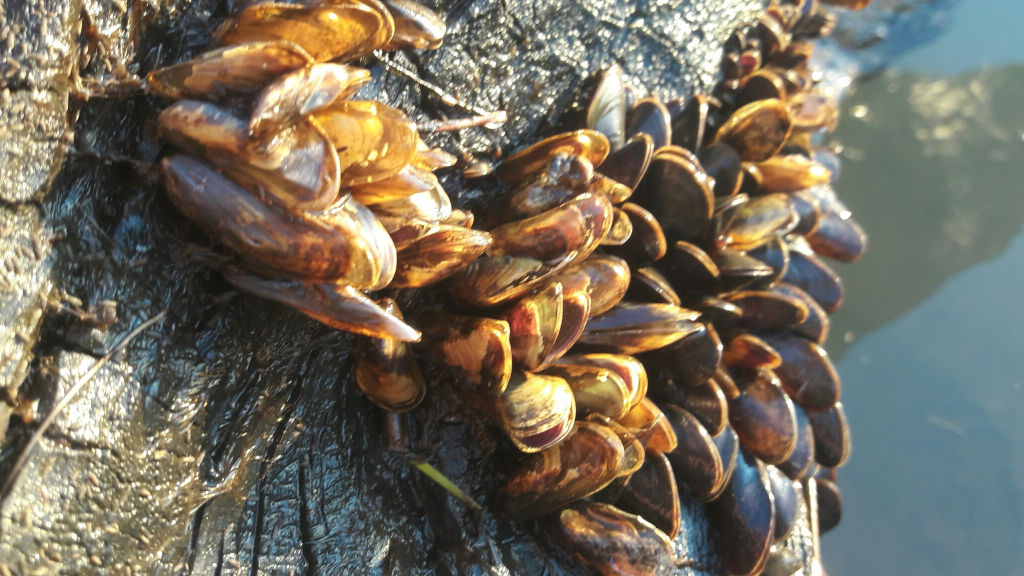
A clump of golden mussels observed in Brazil by iNaturalist user danialdias

Golden mussels are small mussels, only reaching a bit over an inch in length, native to the Pearl River basin in China (the area around Hong Kong and Macau), but have been spread around the world over recent decades with the help of humans, hitching a ride between continents in the ballast water of our ships. Once settled in a new place, they easily move between lakes attached to boats being driven around, since they can live up to ten days out of water (talk about holding their breath!). The mussels first spread throughout Southeast Asia, then to Japan, then South America, and now for the first time, to the North American continent. While they are true mussels, in the same family (Mytilidae) as the more famous saltwater mussels you might have seen in tide pools, they can’t tolerate fully marine conditions.

Why are they a problem?

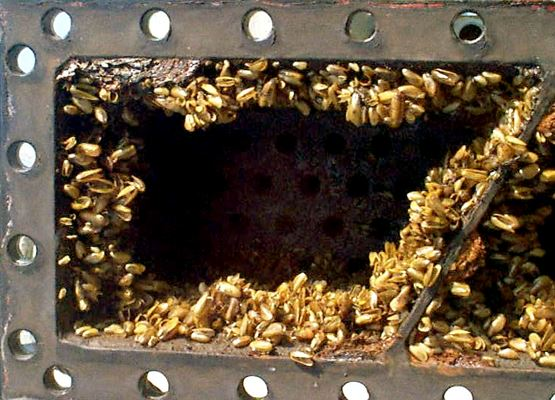
Golden mussels are prolific breeders and make a living by anchoring themselves to any available hard surface using byssal threads. This is relatively uncommon among freshwater bivalves, most of which live on the bottom and don’t attach to surfaces. Golden mussels reproduce by releasing thousands of tiny larvae which spread through the area on river currents. In areas where they attach (such as dams, aqueducts, boats and other infrastructure), they form dense colonies that gum up the works, clogging pipes and and coating surfaces with thousands of their sharp little shells. They can even attach to the roots of native plants and shells of other molluscs and smother them! This causes hundreds of millions of dollars in damages and continuing expense in reservoirs and irrigation systems where they’ve taken hold, like in Japan and South America. If the mussels were to unexpectedly clog the outlet of a Californian reservoir like Lake Berryessa or Folsom Lake, it could be disastrous for people who depend on that water.
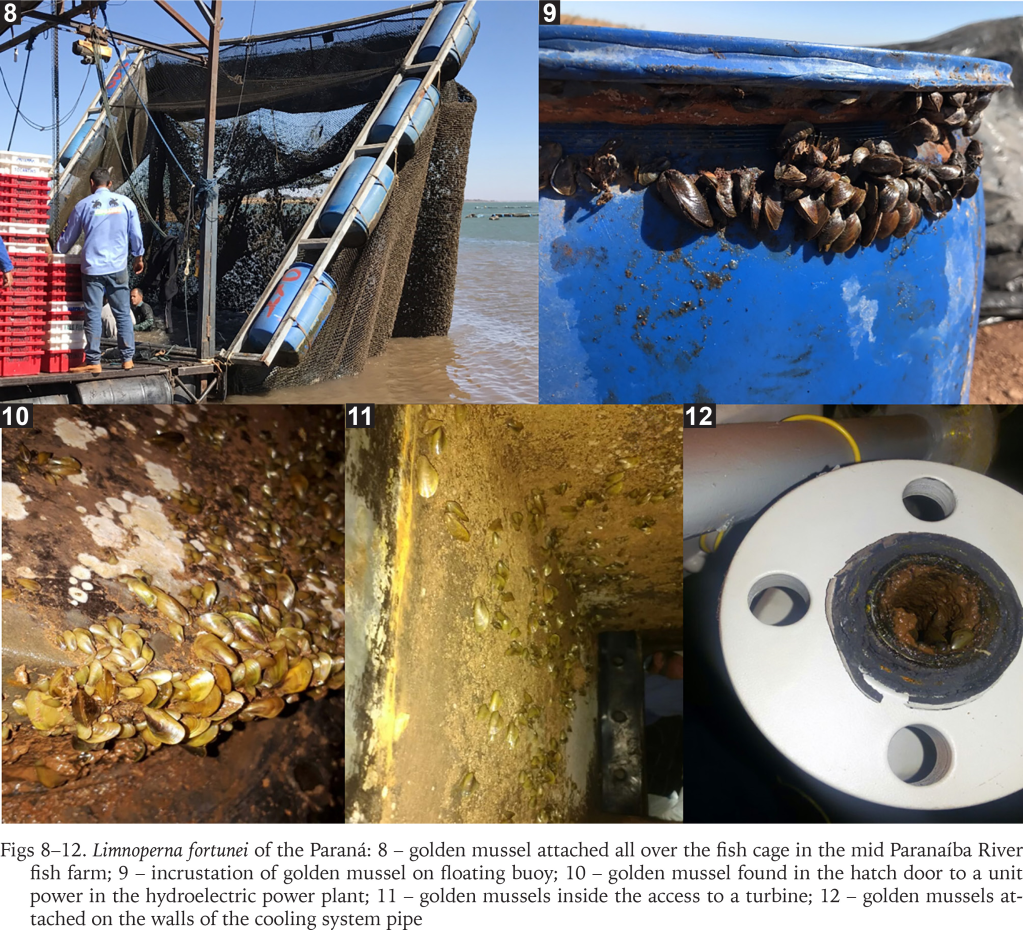
Figures from a paper about golden mussels invading Brazil, showing them coating an aquaculture cage, on a buoy, on a power plant hatch, in the entry to a dam turbine, and clogging a cooling pipe

Quagga and zebra mussels, originally from Central Asia, are invaders in the Colorado River, the Great Lakes, and reservoirs in Southern California. They have been limited from spreading into most reservoirs in Northern California by the low calcium content of lakes here (a function of our local rocks and geology). But golden mussels have lower calcium requirements than zebras/quaggas, so it is likely that they can reproduce in reservoirs up here. They are also surprisingly resistant to low temperatures, meaning that they could potentially take hold in high-altitude lakes like Lake Tahoe, which could be a disaster for efforts to keep Tahoe blue.

Why are they so successful?
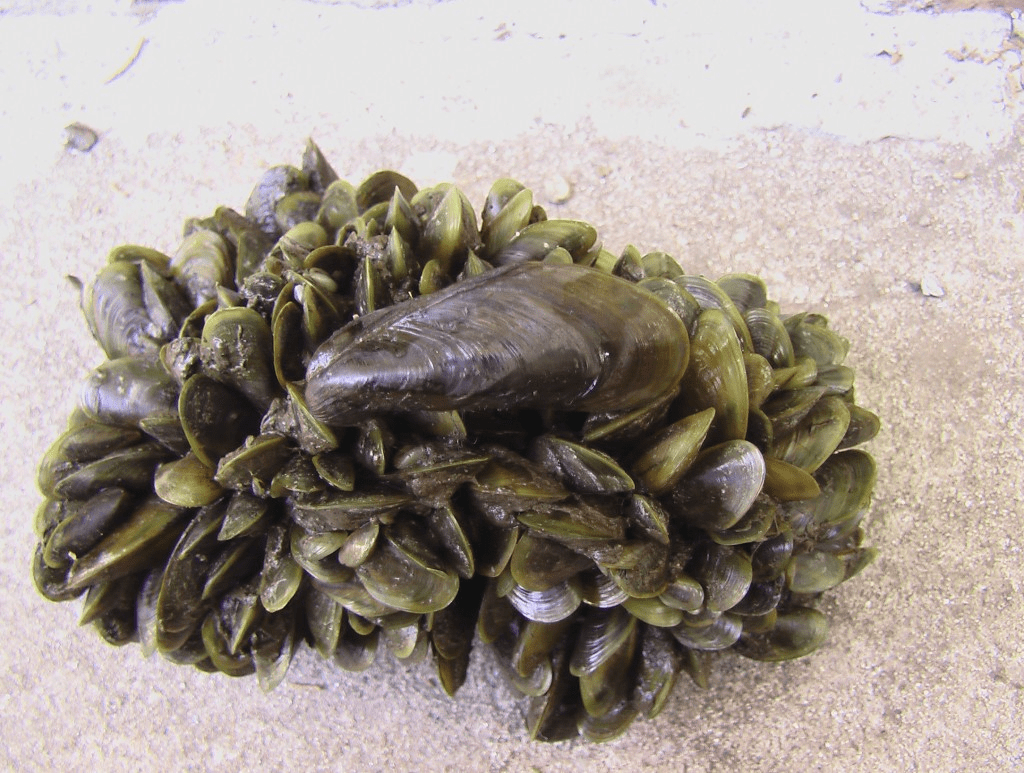
A growing golden mussel colony, with an adult surrounded by younger babies. They only live about 3 years, but what a life they’ll live! Photo by Alexander Karatayev via Great Lakes Echo.

Being so prolific in their numbers allows the mussels to transform the chemistry and biology of the waters where they live. Like most bivalves, golden mussels make their living by using their gills to filter particles out of the water column, drawing them down to their mouth to eat. While individual golden mussels are pretty average in their filtering ability, together they work to much more effectively clear the water than other species, thereby depriving those native species of the plankton food they need, and potentially even directly eating the plankton larvae of other animals around them!
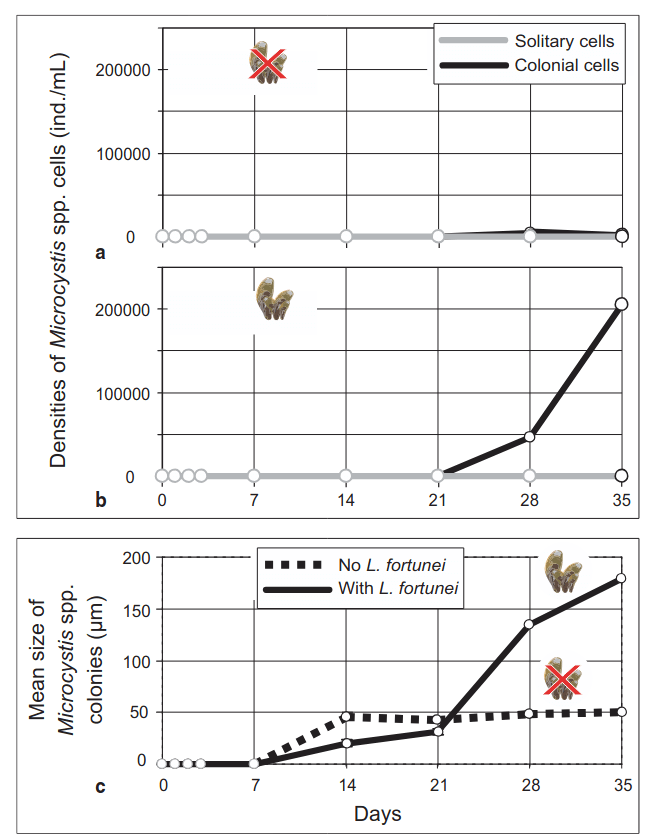
Figure showing how densities and size of colonies of toxic cyanobacteria Microcystis increase in the presence of golden mussels. Yum! Source

The Sacramento Delta has plenty of plankton floating around, so it’s not surprising they’ve decided this is a nice place to live. But while the water-cleaning ability of clams is a useful service they provide, there can definitely be too much of a good thing. The mussels are “ecosystem engineers”, meaning that they make the environment they want to live in. The problem is that what is good living for the mussels is not necessarily the habitat of a thriving Delta. Where they take hold, they exclude native species and generally decrease water quality by trapping dirt and boosting the populations of cyanobacteria. The Sacramento Delta already struggles with toxic cyanobacteria, and don’t need to have the problem be worse! Lower water quality means fewer fish, which is bad for people and the ecosystem.

Why have they shown up now?

corbicula2
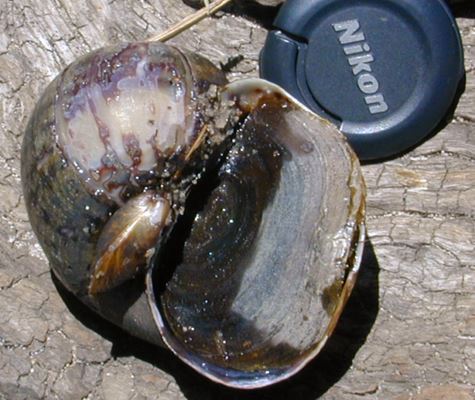
A handful of Corbicula fluminea (Asian clams), a different species of invasive clams in the CA Delta. Photo source

This is actually not the CA Bay/Delta’s first rodeo with foreign clams. Invasions of Asian clams (Corbicula fluminea) and overbite clams (Potamocorbula amurensis) in the 1980s transformed the Bay, with trillions of clams spreading out all the way south towards San Jose and eastward into the Delta after being introduced in Grizzly Bay in the mid-1980s. These clams had enormous impacts on the ecosystem, excluding other bottom-dwelling animals and eating most of the plankton food that other animals rely on. They are thought to have played a major role in the decline of some native fishes like Delta and longfin smelt.

Golden mussels have been making their way around the world over the decades. It is hard for their larvae to survive a couple weeks in the belly of a ship, be released, and successfully take hold, but with enough ships coming to California, it was only a matter of time before all of the stars aligned and a population took hold. We don’t know if the appearance of golden mussels will push out Asian clams, or if they’ll coexist. Asian clams live on the bottom rather than attaching to stuff, but golden mussels may still compete with them for food.

Are there other ways they spread?

Previous studies investigating their spread in South America and Japan determined that virtually all of their spread happens attached to the hulls of ships, in ballast water, or anywhere their larvae can travel downstream. There are rare cases where they are believed to travel upstream in the guts of fish that eat them, being pooped out alive. But those are unusual cases. That also won’t help them spread past dams without a fish ladder. The planktonic larvae have very little ability to swim against the current, so they won’t be able to swim upstream through dam turbines.
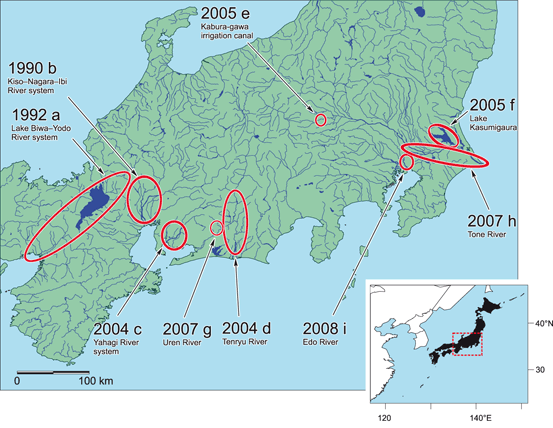
A map and timeline of their spread through Japan. Source
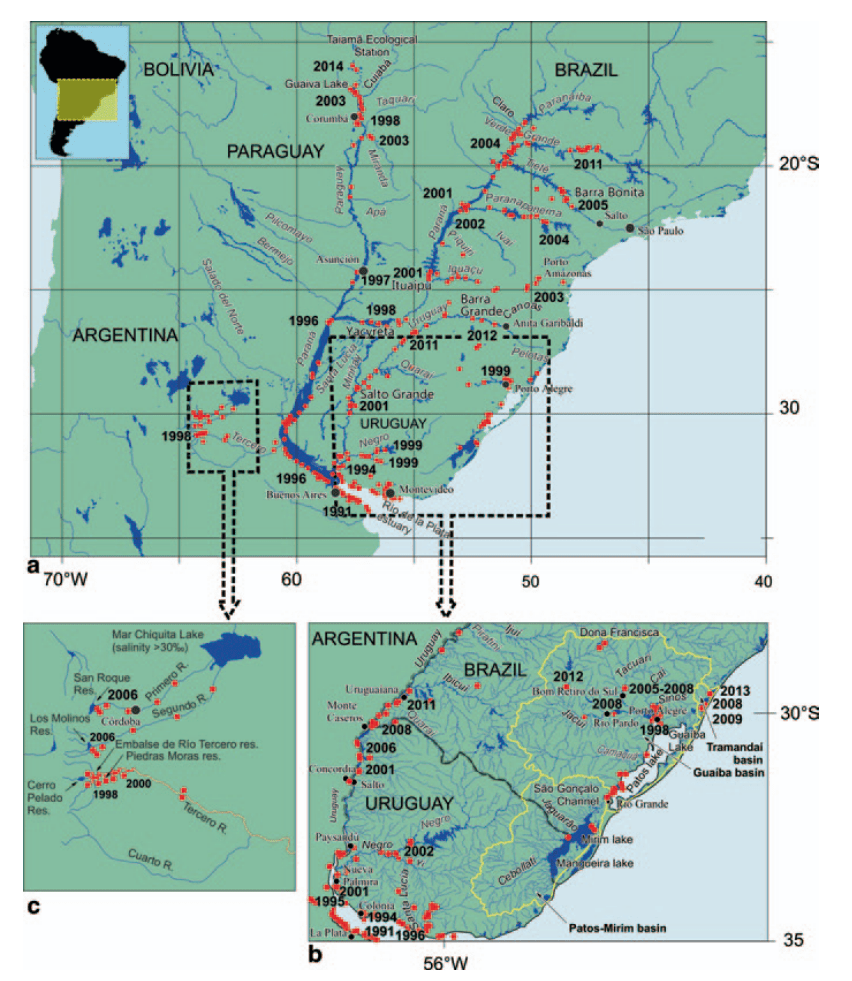
A map of their appearances and spread through South America. Source

Unlike pea clams, which are famous for attaching to birds by clamping their shells on their feet or feathers and traveling long distances to reach new places, it is not believed that golden mussels can create their thread attachment fast enough to hitch a ride on birds (which is a process that takes hours). So fortunately, I can assure our avian friends that we won’t need to inspect them before they use our reservoirs. At the end of the day, human vessels are the main way these mussels are getting around to far-flung places. In Japan, it took around 15 years to spread river to river through the country, while in South America, it covered most of a large area from Buenos Aires to Southern Brazil in that same period of time, which was proposed to be largely due to greater boat traffic in South American rivers.
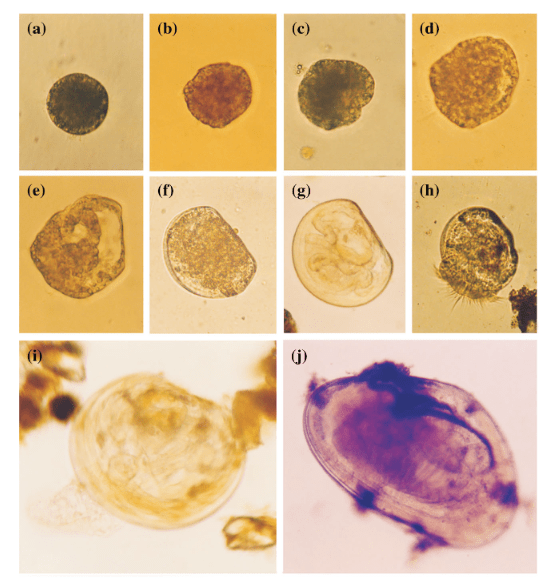
Different life stages of larval golden mussels. They’re cute when they’re babies! The bottom right is the “plantigrade” stage when they attach to a boat, at 0.75 mm size. Imagine scanning a boat looking for one of those!

Are they good eatin’?

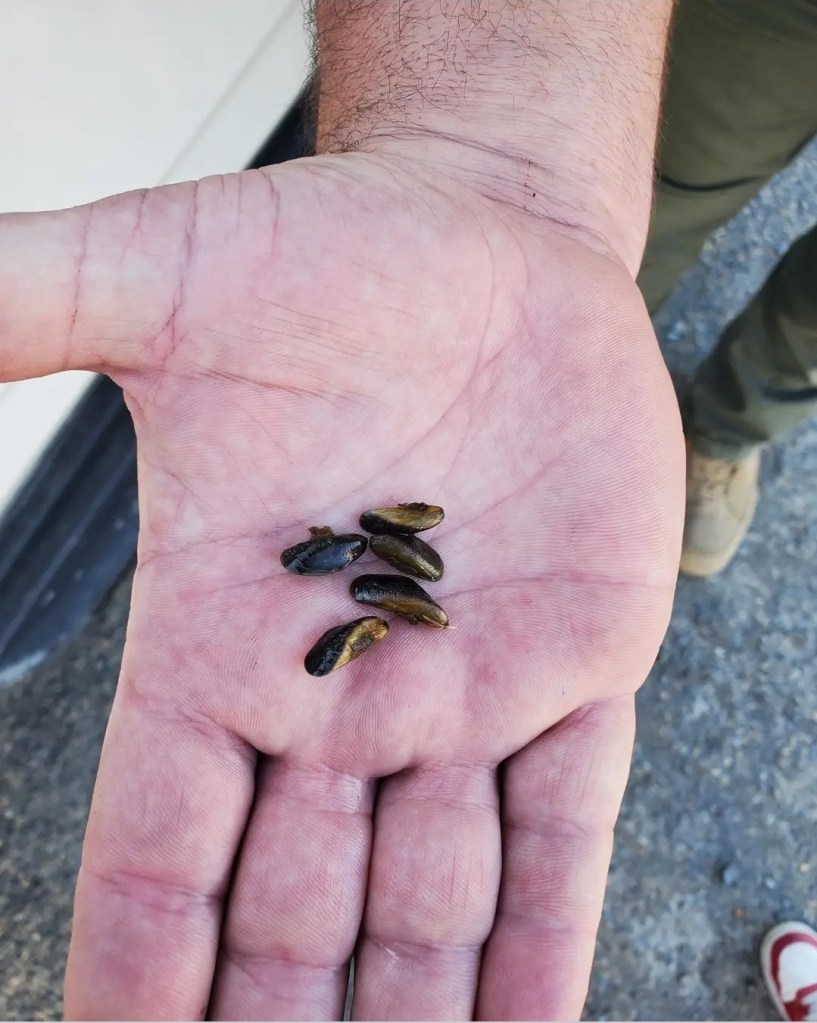
They don’t look exactly appetizing to me. Notice the visible byssal threads! Source: Folsom Lake Recreation Area

These mussels weigh only a little over an inch at best, with not much meat on them. Unlike Asian clams (Corbicula), which are eaten in some Asian cultures, I can’t find mention of anyone eating golden mussels. There have been attempts using them as a fertilizer calcium supplement, but that needs more research. Additionally, it’s known that the other invasive clams of the Bay/Delta are concentrators of toxins, including selenium from farm runoff, heavy metals, and also toxins from harmful algae. In places where golden mussels colonize, toxic cyanobacteria can proliferate, so they actually make themselves a bit more toxic than other clams in the same place would be!
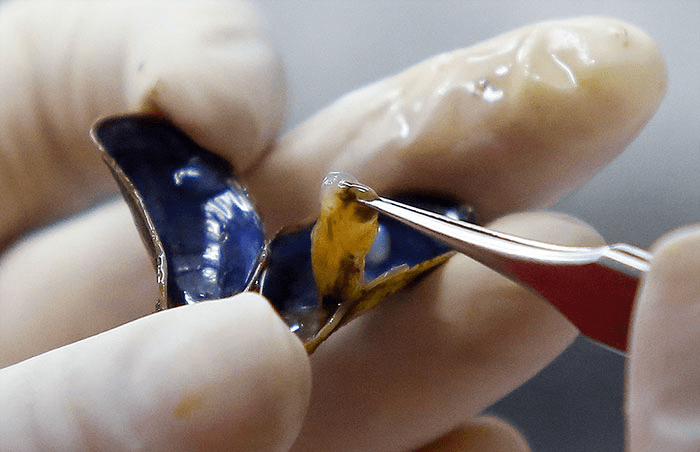
I don’t think these will be taking over the tapas restaurants any time soon! Source

What can we do about them?

We just don’t know how L. fortunei will fare long term in the California Delta and lakes. The previous clam invasions have waxed and waned through time. It’s uncertain whether these mussels will fizzle out, as sometimes happens for invasive species, or if they’re here for the long haul. The speed of their spread throughout the state personally leads me to suspect they’re here for good. And in the meantime, the invasion has caused huge issues for anglers, boaters and dam operators throughout California this summer, who have had to institute boat inspections at every reservoir in the state. Boats have to be painstakingly checked for mussels stuck to surfaces on the hulls.

Eventually, it is possible that mussels will find their way through, despite these precautions. Some could be missed in the crevices of boats entering various reservoirs. But hopefully that will buy time for dam operators to put forth the needed upgrades and develop procedures to keep them from fouling dams and aqueducts. At that point, the objective becomes mitigation rather than prevention. It won’t be cheap, usually involving manual scraping of mussels off of surfaces, application of hot water, pesticides, and use of surfaces that discourage mussel growth.
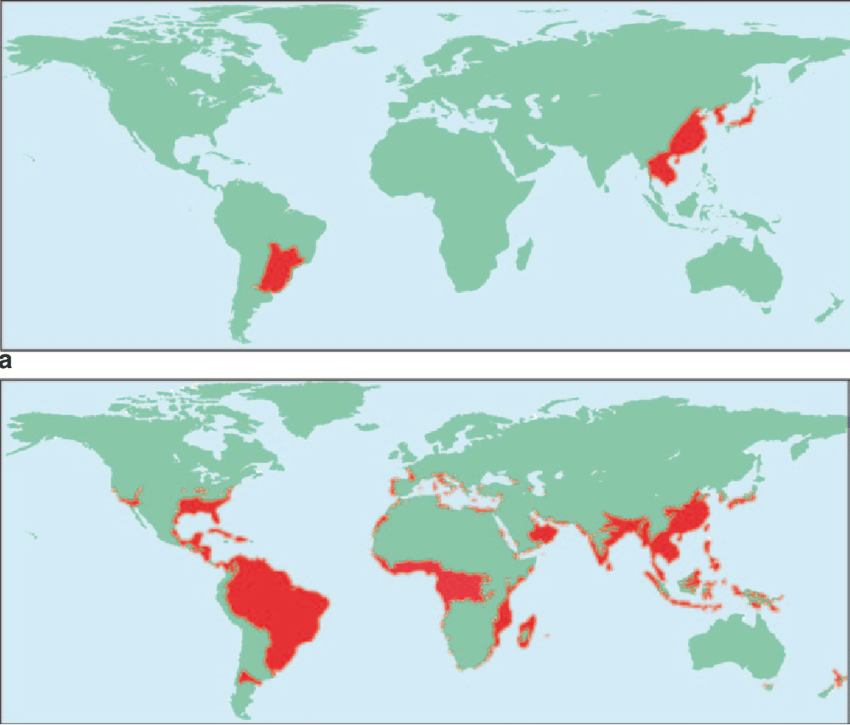
Map from a 2015 book chapter showing their distribution at that time on top, and predicted places they could invade on the bottom panel. Just as the prophecy foretold! Source

Long-term, our invasive species management needs to be more proactive rather than reactive. California was previously recognized to be in the range of territory where golden mussels could appear (see figure above). We can’t allow future invasions to catch us by surprise. To that end, there are laws on the books in California requiring inspection of 25% of incoming ships. So far, we are only inspecting a small fraction of that number. Additionally, ships were previously required to release ballast water far offshore in the ocean, where freshwater species wouldn’t be able to get a foothold. That policy was also not adequately enforced, and requirements to sterilize ballast water with chemical treatments were ruled too expensive. The state government very recently strengthened the standards, but gave ships until 2030 to comply with a weakened version of the rules, and pushed off compliance with the final strongest version until 2040!

People frustrated about such invasive species in California should insist to their policymakers that we can and must do better. There are many more invasive clam species waiting for their chance at a ride over here to make a living in our waters. It’s not too late to stop the assembly line of species coming to displace the native creatures we all love and value!

New job! Where I’m going and how I got here

Richmond, California’s Finances Remain Shaky
Richmond, CA from the air, showing the turbid waters of the SF Bay

Well folks, it finally happened. I found a permanent scientific job. On January 31st, I’ll be starting as an Environmental Scientist at the San Francisco Estuary Institute (SFEI), working on the Nutrient Management Strategy (NMS) program. NMS is a group trying to understand how nutrient supply in the San Francisco Bay works.

The SF Bay is an extremely nutrient-enriched environment (eutrophic) due to human pollution and natural factors, to the extent that if all other factors were equal, scientists would expect it to be a nasty green sludgy mess. Yet up to today, due to factors that are still debated, the SF Bay is in much better shape than it should be. It is not a dead zone, choked off by algal blooms and oxygen-starved in the way that other high-productivity regions such as parts of the Gulf of Mexico have become. Those factors may include the cloudiness (turbidity) of the Bay’s water limiting algae growth, naturally rapid tidal mixing with ocean water, and the influence of clams and other grazing animals keeping the populations of potentially harmful plankton suppressed.

However, there is also evidence that this resilience may be fading as water temperatures in the Bay increase and the ecology of the system changes with climate change. Oxygen levels are dropping and levels of harmful algae are rising, which endangers the health and livelihoods of millions of people in the SF Bay area who depend on a clean, ecologically functioning SF Bay. In my role at NMS, I will be assisting in processing and interpreting huge quantities of environmental data on temperature, dissolved oxygen, water flow, light levels, algae concentrations, and harmful algae toxins, to help figure out how the SF Bay works and how we can protect it. I will be assisting another scientist joining the team in deploying more sensors to monitor the Bay on a minute by minute basis, and also packaging the data to help create models which allow us to figure out the various moving parts that make it work.

In a way, this is oddly similar to the work I’ve done during my postdoc at Biosphere 2, where I’ve been growing giant clams in their 700,000 gallon ocean tank since May 2020. The clams are biological sensors have been recording the environment of the Biosphere 2 ocean through their shells and valve opening/closing activity, and I have had to decode their diaries through comparison with the environmental data we collect on light, pH, dissolved oxygen, chlorophyll and other measurements. The SF Bay is a site of enormously influential research which has been important to understand estuaries around the world, but it is still a mysterious body of water in many ways. NMS is trying to understand how all its complex pieces fit together, much like I’ve been doing at Biosphere 2, which is why I jumped at the opportunity to apply for the job.

I also am excited to get involved in this work because it’s immensely important for everyday people’s lives. The SF Bay provides millions of people with food, employment, recreation and overall well-being, and the science that NMS produces has real-world value for making policy and a concrete plan to keep the Bay healthy. It represents exactly the kind of science that I wanted to do since I first jumped into environmental biology as a 19-year-old at USC. At that time, I was interning at JPL studying historical trends in California rainfall data, so this new job represents a homecoming of sorts to California water science!

This job will be a bit of a change of pace from my present work as at first, because I’ll be part of a scientific team with a shared mission, unlike most of my prior research, where I came up with ideas, pitched them to my advisors and funders and then coordinated the projects to collect and analyze data. There will be more teamwork, and while academic publications will still be one of our products, we also will be writing reports for policymakers and stakeholders who are deciding on how to regulate nutrient levels in the Bay.

I also won’t be working with clams on an everyday basis! But as I mentioned before, clams do play a major role in the Bay in terms of filtering the water, and so it is likely we will need to understand the activities of the clams and other grazers to explain the trends in nutrients that we see. I didn’t start as a Clam Man, but my curiosity about clams meant that my attention kept being drawn to these enigmatic but influential creatures, and I expect that dynamic will continue. I am, and always will be, Dan the Clam Man.

I will continue to get my present clam projects out the door as publications, so there will be lots of clamsplaining in the future months as those get out the door. Regarding the Biosphere 2 clams, we still have four individuals of Tridacna derasa (the smooth giant clam) growing in the 700,000 gallon ocean tank, and intend to leave them as long-term research subjects and an exhibit for visitors to enjoy and learn about. We also have proposals in the work for new projects to expand on this work. I hope I can continue to visit in the coming decades and see our clams grow to be true giants, two feet in length! I also hope to acquire pet giant clams of my own, with names rather than specimen numbers, to be my friends rather than my research subjects.

I’ll be starting the new job remotely at the end of this month, to give myself time to tie off loose ends in Tucson, intending to move to the Bay Area by March. I will really miss Biosphere 2 and Tucson, but this isn’t the last they’ll see of me, because my collaborations with people here will continue into the future. I knew from the start as a postdoctoral researcher that my position would not be permanent, but it is still bittersweet to leave. I will miss hiking in the Sonoran desert, swimming in the Biosphere 2 ocean tank and also my advisor Diane Thompson and her lab here, full of people who have been a joy to work with.

But I am excited for this new chapter, because the postdoc life has been lately losing its luster for me. I’ve enjoyed being a postdoc for the freedom it entails, both in my research topics and the way I structure that work. But postdoc work is emotionally exhausting, as I have been a journeying academic contractor on “soft money”. My employment for the following year has always been contingent on the next grant coming through. Moving between different institutions on different continents has been a big weight on my family and my partner, who I miss greatly.

As a postdoc, while I’ve had fun and wouldn’t change anything about it, I have felt like a plane trying to take off in unfavorable weather. I could see the end of the runway approaching as my current funding ends in May, which was a scary feeling. I’m willing to hustle and fight for research funding, but not my basic income. Looking back, I have applied to around 45-50 academic positions (including postdocs) since finishing my PhD and got interviewed for less than ten percent of those, and received offers for two postdocs. When I got the offer from SFEI, which was itself a rigorous, multi-stage process over months, I cannot describe what a relief it was to clear out my “job applications” folder in my to-do list. This SFEI job will allow me to pursue marine science that helps the environment and people, in a more emotionally sustainable way.

I’m excited to start my next chapter and share with you all the discoveries our team makes about the SF Bay, while also continuing to clamsplain here on my own time. Keep an eye out for my Biosphere 2 studies, which will be rolling out over the next months as the data arrives!

The insidious cost of increased class sizes: A TA’s perspective

UC Santa Cruz, like all UC schools, is in the midst of a massive regent-mandated effort to increase enrollment. In the face of a governor hostile to the idea of investing in education (despite his prior promises), the regents have decided that we are going to grow our way out of the budget shortfall. Much has been said about the foolishness of this plan from the standpoint of housing, student tuition and access to resources, but I thought I’d talk about the cost it has had on me personally as a Teaching Assistant (TA).

TAs are usually graduate students working on a doctorate or master’s degree. We are paid 50% wages on the assumption we spend 20 hours a week working on TA stuff to support our other 20 hours (ha!) of work a week on our thesis and classes. Our tuition is waived and we receive health benefits.

In the last two years, my department’s academic division has been cutting TAships while pressuring the department to enroll more students. For four years, I’ve been teaching the lab section for Environmental Geology (EART 20), which has given me a natural laboratory to note the impact that increased class size has had on my instruction. I’d also note that my experience has been less extreme than other TA’s because EART 20’s enrollment has been flat overall during the time I’ve taught. But the lab section has doubled in size from 22 to 45 students, possibly because we have more majors declaring and they need the lab credit for their degree.

Here are some ways my instruction has been impacted by doubling of students:

Grading time

As a TA, I am supposed to only spend 20 hours a week on instruction. I’m literally not allowed by my union to spend more time than that. And fortunately, because I have been able to slowly tweak my lesson plans over many years, I now have a lot less prep time than I did when I started teaching this class. The lesson plans are already put together, and I can just focus on polishing and perfecting the lessons. However, the time I need to grade has ballooned to at least double what it used to be. I say at least double, because I usually get tired after the 30th lab and start to slow down.

My detail in grading is also impacted because I cannot spend as much time looking and commenting on each student’s assignment. So while they’re paying higher tuition than their compatriots from four years ago, they are getting less instructor time dedicated to feedback on their work. Note that our department has tried to make up for this by hiring graders to assist TAs, but I insist on grading my own labs because I need to understand how students are learning and responding to my assigned material.

Less physical space for students

Our building used to have large, luxurious desks perfect for specimen-rich lab sections. But they unfortunately couldn’t fit more than 20 students in a room with those so they have put in smaller, flimsy desks to stuff more students in. These desks are narrow and crammed together to allow up to 30 students in the room. As a lab instructor, I prefer to walk around and answer student questions looking at the specimen we’re talking about until they understand and have that light-bulb moment. But I can’t do that anymore because the desks are so close together. So instead I now sit at the front of the room and they come up to me. I hate this and I know I get less questions than I would if I could walk around. It is another way that they aren’t getting their money’s worth.

Less interactivity

The UC claims to be a big cheerleader for the active learning style of teaching. Active learning is different than the classic lecture-based format in that exercises are designed to maximize student participation and interactivity between the student and instructor, hopefully leading to learning by experience rather than example. But active learning requires more grading time and a different classroom layout than the classic lecture format. And I have had to revise my labs over the years to reduce interactivity out of necessity. In the past, I’ve made a landscape out of play-dough for students to map out topographic profiles. This year, there were just too many students for it to work. They scrunched together around the model, with some deciding to wait until my office hours to get time doing it. It was sad to watch this. Next time, I’ll make two models to space through the room so it isn’t so claustrophobic.

Take-away

These problems are only going to get worse, as our department is currently under pressure to increase enrollment and has less TAships to offer every year. We are often criticized for our low student to instructor ratio! Yet tuition is increasing. Students are getting less value for the same course offered four years ago. I’ve observed it with my own eyes. I feel a pang of sadness each lab section seeing the ways it reduces the quality of instruction. I spend more time to try to lessen the impact of these creeping changes, but something’s got to give. I hope Californians realize that the value of our legendary UC schools is under attack. I hope we invest more into education and don’t forget that the UCs helped make our state great. I hope Jerry Brown cements his legacy by increasing UC funding.


People (and frogs!) before cows

It was hard not to feel irritated as I opened the homepage of East Meadow Action, a grassroots group recently formed to defeat the development of Student Housing West (SHW), particularly regarding the Family Student Housing project on East Campus. The group has its heart in the right place. They believe that the field at the base of campus is a setting deserving of preservation, and are trying to prevent the building of new student housing to achieve this goal. I’m writing this to counter a number of points brought up on their site about the planning and design of SHW. I feel qualified to discuss this matter because I’ve been serving as a graduate student rep on the planning committee for the project since its early days last summer. From the start, I’ve been dedicating my efforts to keeping the project economical to ensure lower rent and as dense as possible, to prevent campus from sprawling into land needed by wildlife. I’m sorry to say that East Meadow Action’s efforts to defeat construction will harm both students and the environment if they succeed.

Student Housing West is an enormous planned development on the West side of campus designed to house ~2600 undergraduates, 200-220 graduate students, nearly 140 apartments for student families and a childcare facility. Well, it was initially planned to be on the west side of campus, beginning below Kresge College and continuing down the hill to the current site of Family Student Housing. That was the site university administrators provided for developers pitching their concepts for the project in an extended series of meetings last summer. We selected one developer, Capstone Development Partners, because of their proven track record of student housing construction and management. I personally voted for them because their plan had the highest goals for sustainability and the team made it clear that they would work to adapt to any contingencies which would surely arise during the future planning process.

rana_aurora
The red-legged frog. Apparently Californians ate them to near-extinction, no joke. From Wikipedia.

It turned out that their promised adaptability was put to the test when we were informed that nearly half the site would not be usable for construction. It turns out that a very cute and endangered species, the Red-Legged Frog, uses that corridor for their annual migration from the northerly forests to the grasslands near the Arboretum. Capstone suddenly had to work with half the space that they had initially anticipated for the 2800 students destined to live at West Campus. In addition, it meant there would be no housing prepared for current families living in Family Student Housing (FSH) when it was torn down to make room for the new development.

shw-sites-aerial
Aerial view of the two sites. Source: UCSC CHES

This news could well have killed the project. SHW would not be built in time. Students would be left to fend for themselves and find housing in town on Craigslist. But members of the planning committee discussed another site for the new FSH, one which I have long personally considered a waste of space: the “meadow” near Hagar and Coolidge Drive. As an environmentalist and earth scientist, I bristle at the suggestion that the field at the base of campus is some kind of natural grassland. This space is heavily damaged; if it was left alone, it would return in a few decades to being redwood forest much like North Campus. But it hasn’t been left alone. It is instead a haven for domestic cows which graze and trample the space year-round. The animals, while endearing, continuously roam mowing every blade of grass to a stub, happily emitting methane on a prime piece of real estate.

IMGP3684-ANIMATION
The cows declined to comment on their thoughts re: Family Student Housing.

Perhaps the current ongoing environmental review of the site will find that the land is needed by some sensitive species other than domestic cattle. If that turns out to be the case, then I will shut up and the project will probably need to restart at the drawing board. But some of the “alternative sites” that East Meadow Action assures us are available on campus (but never get specific about) seem far worse to me. Some possibilities include the forested land north of campus or the trailer park on the Northwest of campus. Both of these places seem much worse candidates to pave over to me in terms of ecological value (redwood and oak woodland) or their need for people (the trailer park is some of the most affordable housing on campus and much beloved by the students living there). I would much rather pave over cow pasture than a forest or someone’s home.

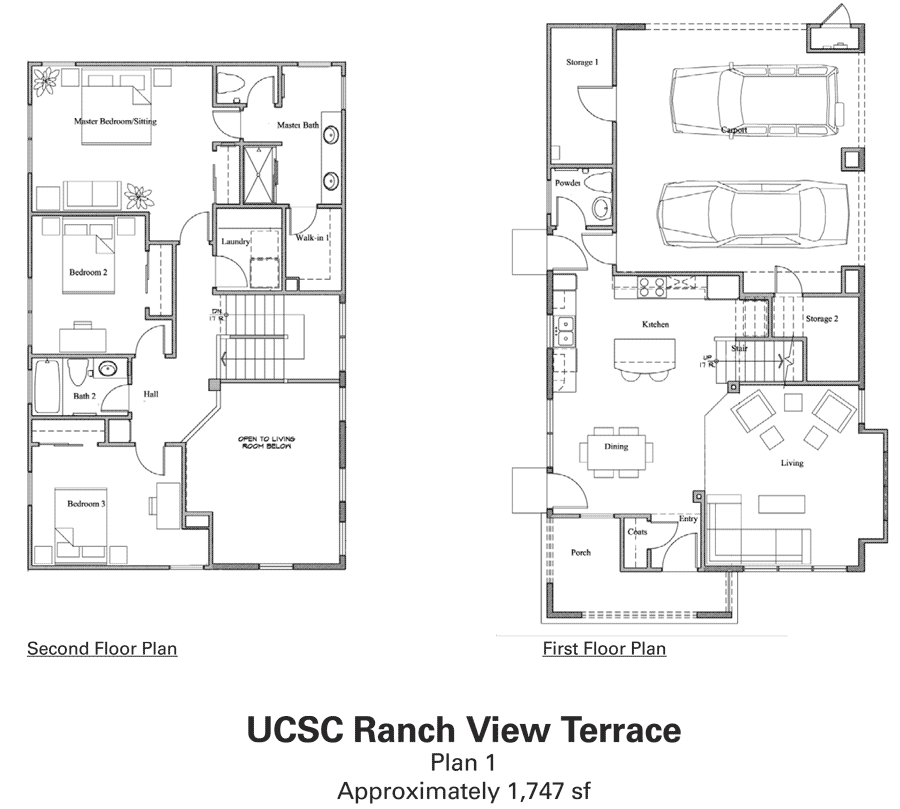
When I read through the website of East Meadow Action, I am struck that the centerpiece of their argument is the aesthetic value of lower campus as open space. I confess that I find this extremely irritating. It’s irritating to me because aside from being an advocate for conservation of sensitive species like the red-legged frog, I am also a student who has to get by living in this town, and I don’t have the luxury of worrying about aesthetics. When they mentioned Ranch View Terrace as an example of “building done responsibly”, my opinion was sealed. Take one look at the floor plans described for the single family homes of Ranch View Terrace, “a large housing complex set back from the road and mitigated by vegetation and topography.” How exactly are we going to house 2500 students in single family homes, artfully hidden behind trees? East Meadow Action is not motivated by environmentalism. They’re motivated by the same Not In My BackYard mentality that is choking the development of dense housing in town. We are in a housing crisis and their ocean views are a luxury that we can’t afford.

plan1
East Meadow Action’s ideal for student housing.

I agreed to be SHW rep because I want to make sure future graduate students will have an affordable housing option on campus. I currently am “lucky” to spend 40% of my stipend on rent in town. When I first came to attend grad school here I had to deal with Craigslist and ended up paying over 60% of my income for the first two years I lived here. Students are pursuing extreme solutions. I know people considering living in the woods, or in unzoned bedrooms in town that are another source of tension with the community. It will only continue to get worse as rents rise in the coming years.

Right now, all we can do to remedy the issue in Santa Cruz is pass rent control ordinances and increase supply. SHW is the best project we have to increase supply and do so ensuring maximum density. I want UCSC to continue to be a forest campus, which necessitates not chopping down trees. I am trying to ensure that students have an affordable housing option on campus. I want student families to have guaranteed housing that comes online right when their previous outdated complex is torn down. The sentimental affection that some may feel for the aesthetics of a cow pasture strikes me as the privilege of a comfortable and vocal minority. I value the croaking of frogs and the laughter of children over the yammering of NIMBYs and, yes, even the mooing of cows.

Dan Killam

Fourth Year PhD Candidate, UCSC Earth and Planetary Sciences

University of Southern California ’12, BS Environmental Studies

Graduate Representative for Student Housing West