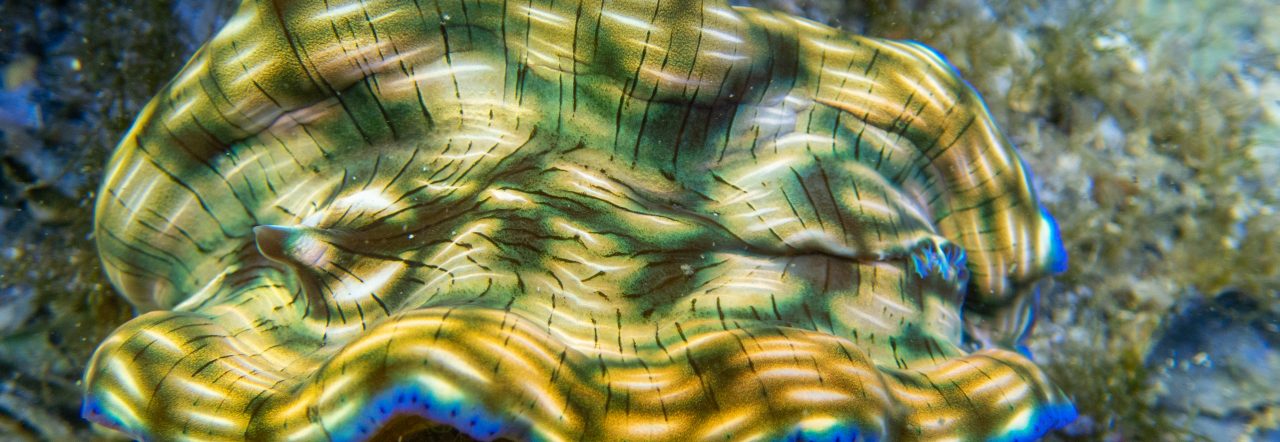
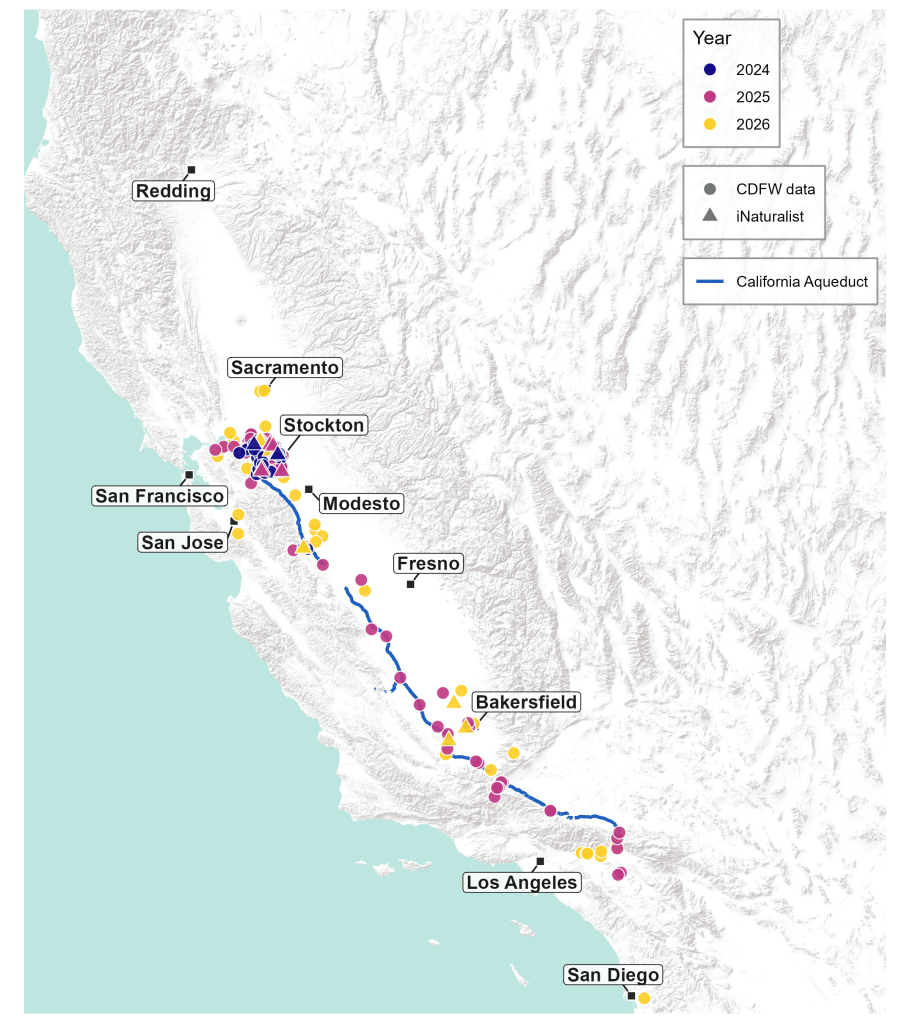
Since its initial appearance in California in October 2024, the golden mussel, Limnoperna fortunei, has accomplished Big Things. These little mussels, native to the Pearl River Delta in China, have taken off from their initial foothold in Stockton to spread all the way south to San Diego, and have been spreading northward as well in recent months. It has been an extreme couple years for CA invasion science!
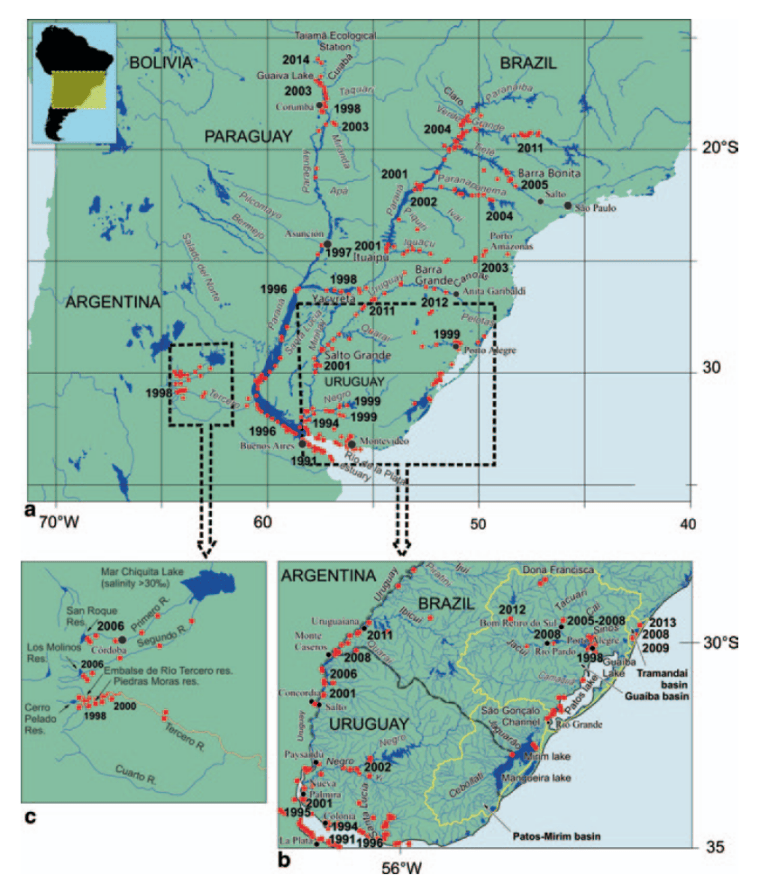
As I described in my previous blog, golden mussels have spread from China to Japan, Argentina, and Brazil before appearing here. Previous researchers noted that California represented a great environment for them to settle, with conditions pretty similar to the Rio De La Plata Estuary in Argentina and Uruguay, where they first invaded South America in 1991, spreading up through the rivers attached to ships until they reached Brazil. More recently, they have reached the edges of the Amazon.
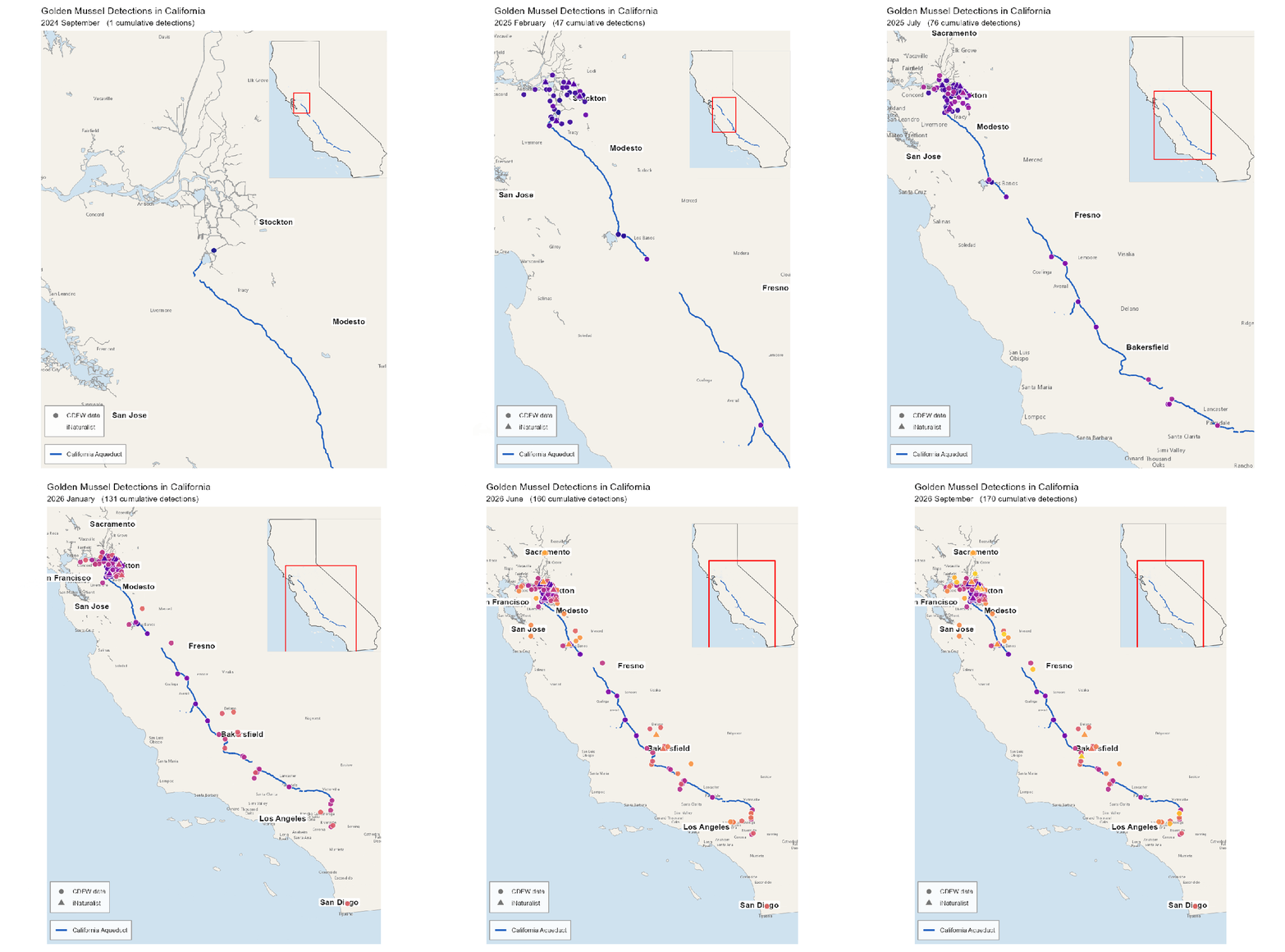
But the rate of spread in California has been faster than in South America, because of the transport provided by the California Aqueduct. Data collected by California Department of Fish and Wildlife tell the story. Mussels were first observed near Stockton in September and October 2024, likely brought in the ballast water of a ship traveling from one of the regions they’ve already invaded. They quickly distributed over the following months through neighboring areas of the Delta, probably mostly from the tidal flow carrying their larvae. Researchers at Contra Costa Water District began to observe them on their settlement plates that they used to monitor for zebra mussels in their reservoirs. The mussel larvae then were observed near Tracy in November, where the main pumps leading into the California Aqueduct are located. Even before that, they had been observed at the San Luis Reservoir far down the aqueduct in October. Over the following months in 2025, the mussels were free to head down the entire aqueduct, piped directly to Southern California. Along the way, they were sucked into various reservoirs connected to the Aqueduct, such as San Luis Reservoir, Pyramid Lake and even reservoirs in San Bernadino. By early 2026, they were observed at the Sweetwater Reservoir in San Diego County (which also has water sourced from the California Aqueduct).
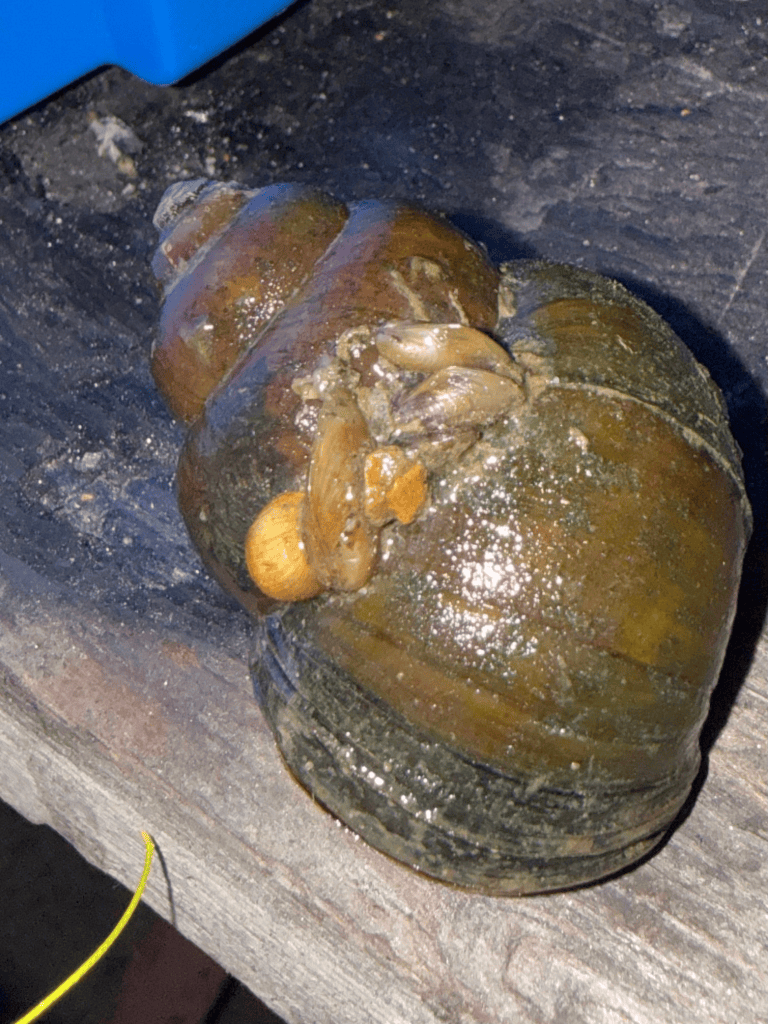
It’s important to note that there was really nothing that could be done to stop the mussels from getting into the Aqueduct, once they had infested the Delta. This is a water supply that millions of people rely on for drinking water, irrigation for crops and other uses. We can’t just turn off the pumps, because lives depend on this water consistently making its way south, and the mussels unfortunately used that to their advantage. The California Aqueduct is one of the engineering wonders of the world, but its amazing ability to transport water over mountains and to dozens of reservoirs has also made it an amazing way to transport mussels.
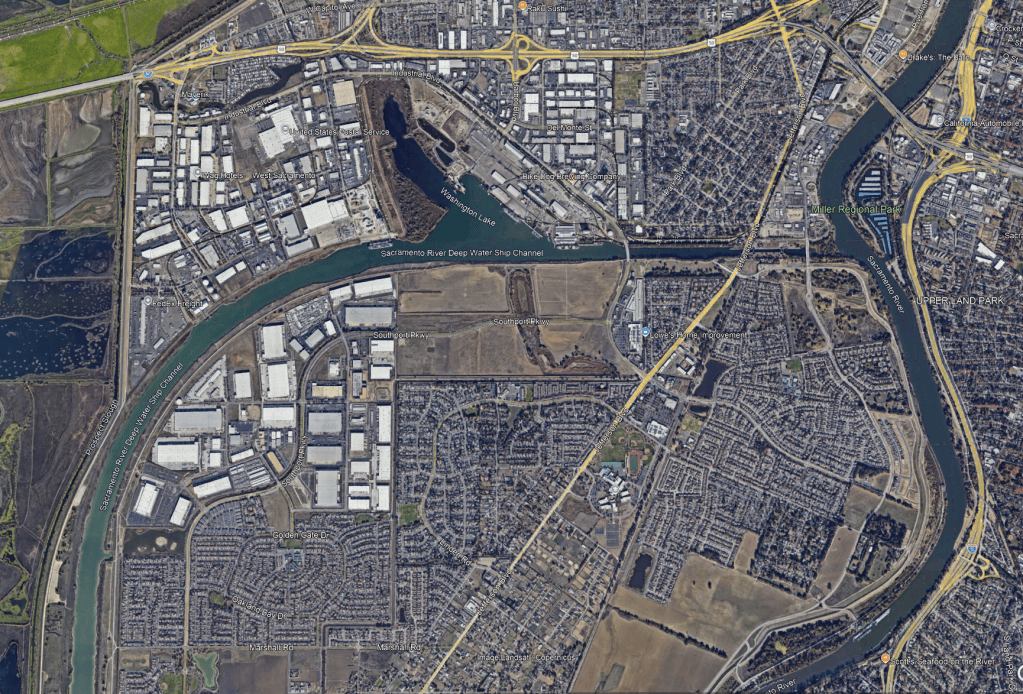
It has taken the mussels longer to move upstream against flow, where they need to attach to boats for a ride. But in 2026, they have begun to move up the Sacramento River to the North and the San Joaquin to the South. In June 2026 they were observed in Lake Washington in West Sacramento. Lake Washington is a popular place for boating, and it is quite likely they got there by attaching to boats, either brought to the Lake over land on trailers or via the Sacramento Deep Water Ship Channel. Lake Washington looks like it doesn’t directly connect to the Sacramento River to the east, since it ends with a couple disused locks (anyone, write to me and correct me if I’m wrong!). So it may represent a dead end for the mussels, unless someone takes a boat by land to enter the Sacramento River from there. Once mussels reach the main Sacramento River, it will be open season for them to head far north towards Yuba City attached to boats. Similarly, in the southern direction we are seeing them approach Fresno along the San Joaquin River, likely with the help of boats.
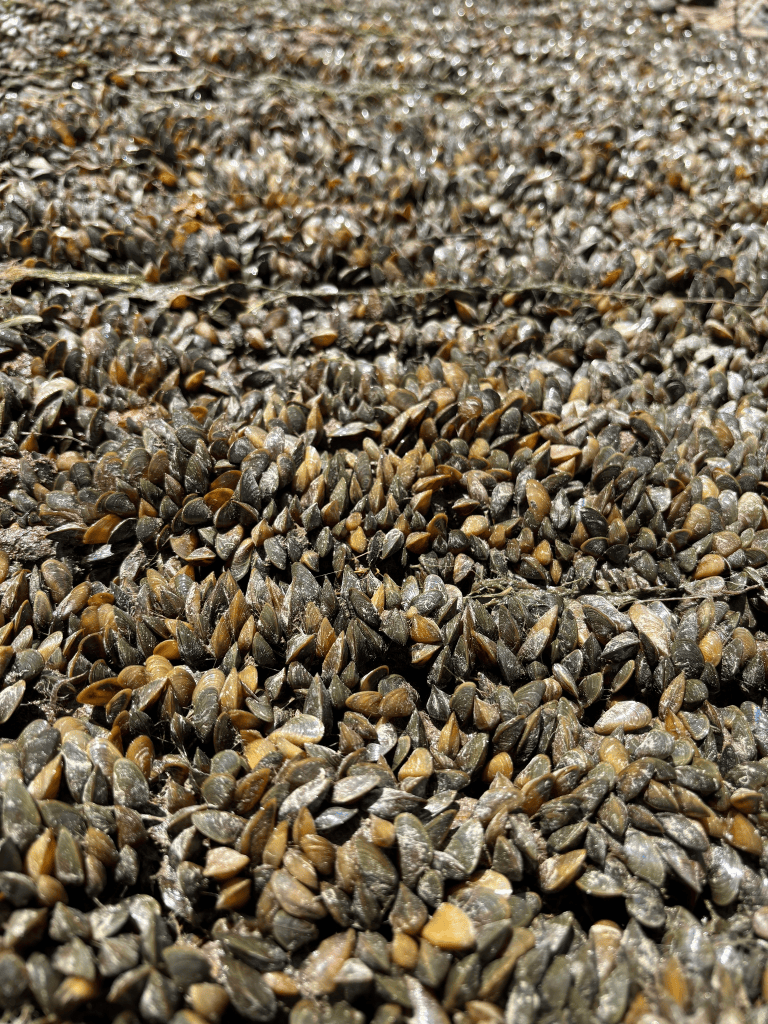
So to review, in the two years since introduction, the mussels have spread to cover 400 miles of California, from San Diego to Sacramento (~200 miles/year). In South America, it took seven years to travel ~1200 miles from Montevideo, Uruguay to Corumba, Brazil (~170 miles/year). The California mussels are moving slightly faster per year here than they did in South America! It’s awesome that California Department of Fish and Wildlife has collected this data and made it accessible. It provides an unprecedented view into the invasion in real time, that clam people like me have been watching with horror over the last couple years. That has been one inspiring part of this whole situation to see: state workers (and various municipal, county and federal agencies that submitted data) are at the front line of protecting our water supplies and environment from the threat of these invasive pests! Similarly, citizen scientists on iNaturalist have also contributed observations of scientific interest, helping fill in the map over time. We all need to work together to track these mussels!
Note that in many of my descriptions above, I specified in many cases when mussels were “observed”, which is different than when they first arrived. The mussels are tiny and stealthy in their first weeks of life after attaching, basically impossible to see on the side of a boat or pier among the algae and dirt. They are often only observed when they get to be a centimeter long or so. When mussels were first observed at a couple sites near Stockton, CA, they had already infiltrated the aqueduct and were settling all along it!
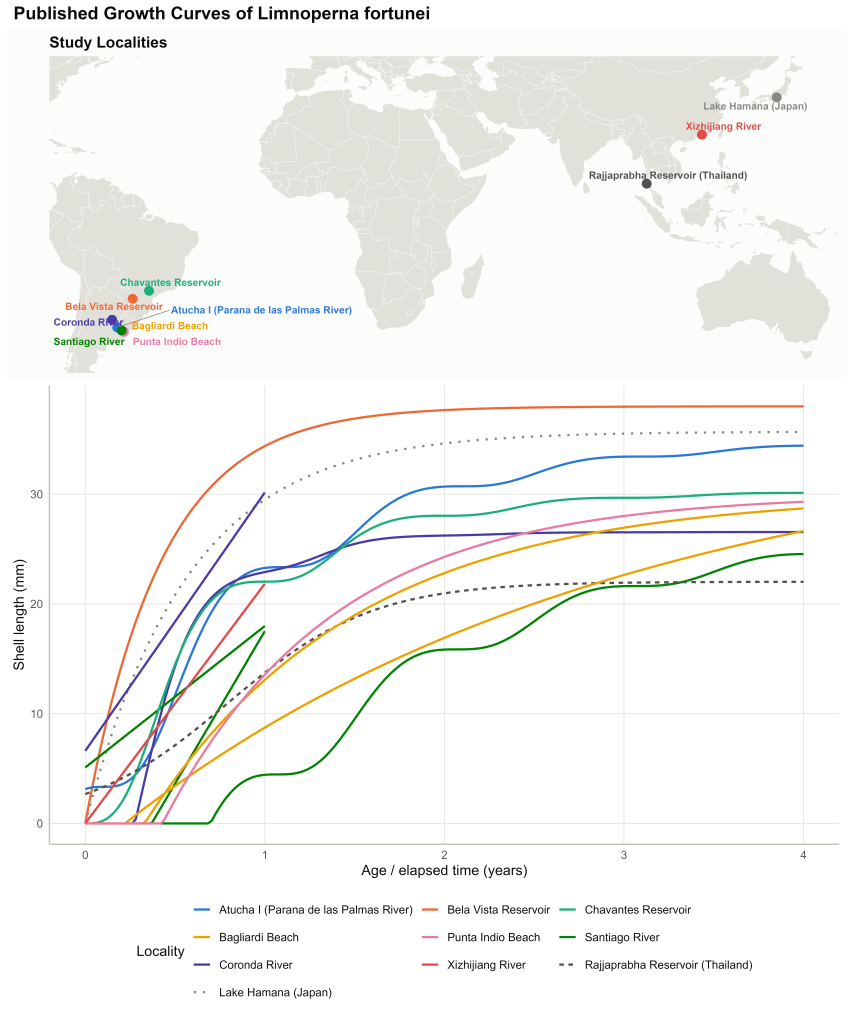
We can try to track back when these mussels first attached to a surface (and therefore potentially when they were introduced) by using the size they were observed at and calculating their “birthday” based on their growth rate. But as is seen in many bivalves, these mussels can grow at very different rates depending on where they are. In the warm tropics of Brazil and a site in Japan, they have been observed to grow to their maximum size of over 3 cm in a year (very fast for bivalves!), but in cooler, saltier or polluted places they will take two or even three times longer to get to that size. In California, they were already being observed at over 3.5 cm long in late 2024, suggesting that 1.) They are very happy in CA and grow very quickly, and 2.) They may have been introduced here as early as 2023!
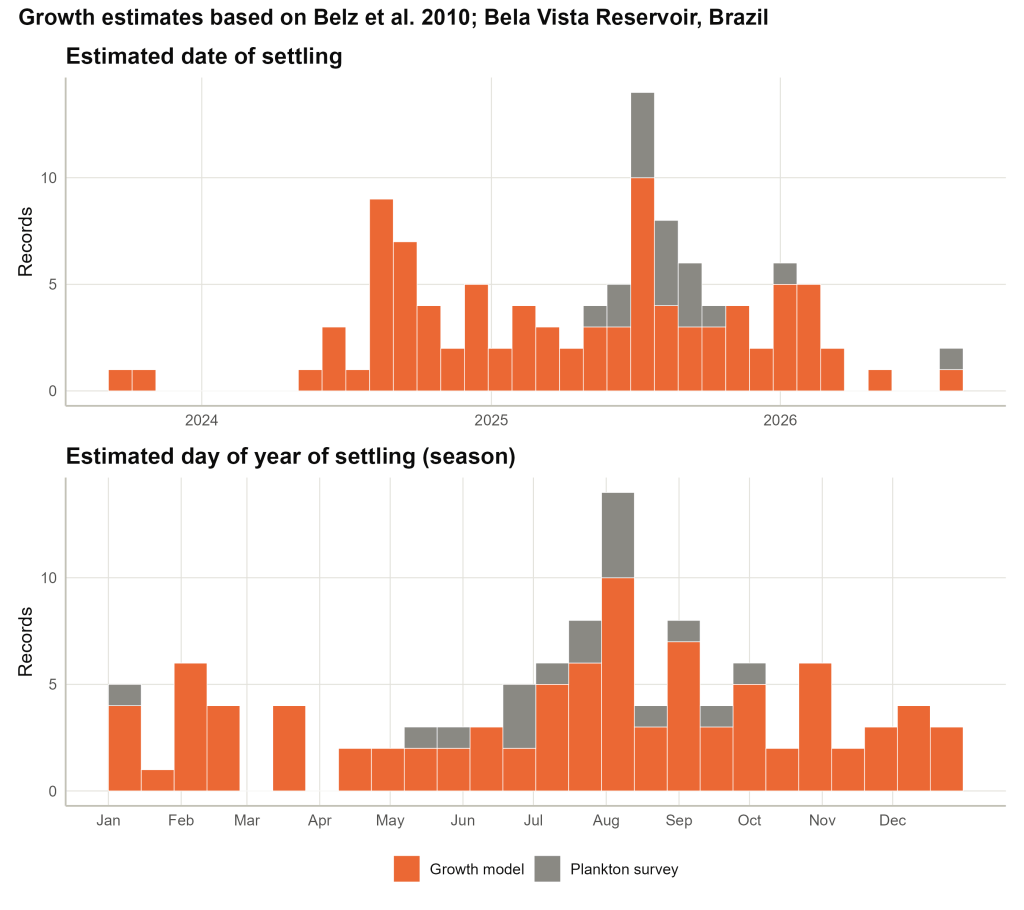
If we use the fastest growth estimate I could find, from Bela Vista Reservoir in Brazil, and trace back all the reported sizes of mussels from the state database, we can estimate the times that they first settled and started to grow their shells. We see that according to this estimate, they arrived as early as late summer 2023. We also see bursts of settlement in late summer 2024 and 2025. This is corroborated by observations of planktonic mussel larvae, which seem to peak in the summer months. So late summer seems to be their preferred time to spawn, probably driven by temperature, but there also may be other bursts of reproduction at other times of year in different places!
I am hoping to help collect data to create a better growth curve for these mussels specific to California, so we can improve these estimates of when exactly they arrived and how quickly they can be expected to become an issue as they show up in more places in California and elsewhere. Knowing the rate and seasons they grow will be very important to water managers that are having to make investments in fighting these mussels via equipment upgrades, new water treatments, and other solutions. I am hoping through the power of science, we can try to protect our water from these invaders, and by understanding how they got here, I hope we can prevent new invasions of different bivalves from happening!
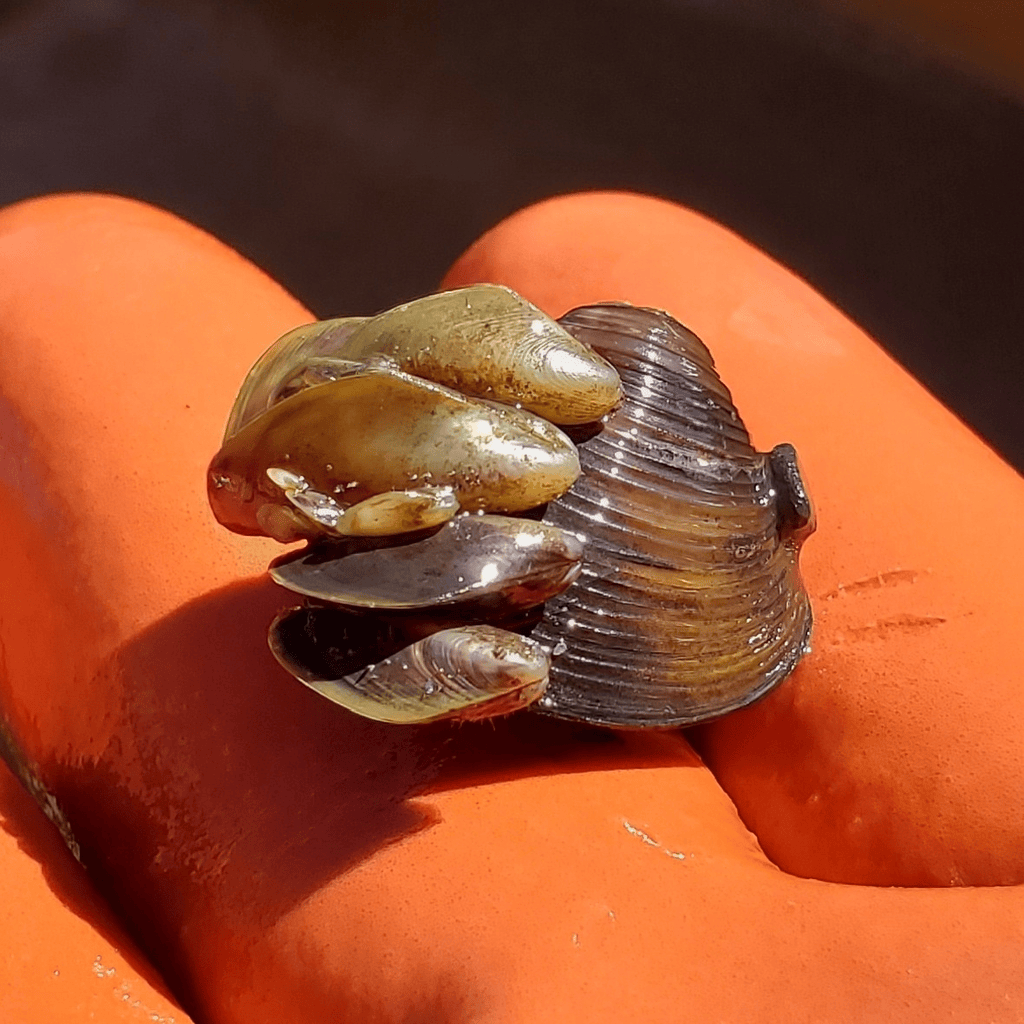
Unfortunately in the case of these golden mussels, it seems certain at this point that they are here to stay in California. I find it likely that over the coming years, they will spread throughout California and to other neighboring western states. Personally, I am concerned about reports of them appearing in Suisun Marsh and even brackish areas of Grizzly Bay. Golden mussels can live in brackish water, but the exact upper end of salinity they can tolerate is not fully understood. Joining forces with the other invasive clams that have already re-engineered SF Bay since the 1980s, I worry we will again see a wave of ecological effects take hold in a place which has already suffered so many impacts from invasive species. I hate to end on a negative note, but I think this should be a warning shot for Californians that we are not doing enough to prevent invasive species from taking hold. We should not have had ships dumping their ballast water in the water supply that millions of people rely on, introducing mussels (and who knows what other species) into our midst. I hope policymakers will understand the urgency of this threat and work to make this the last major invasion of a bivalve for our state!

