Research Explainer: How giant clams record their diet in their shells

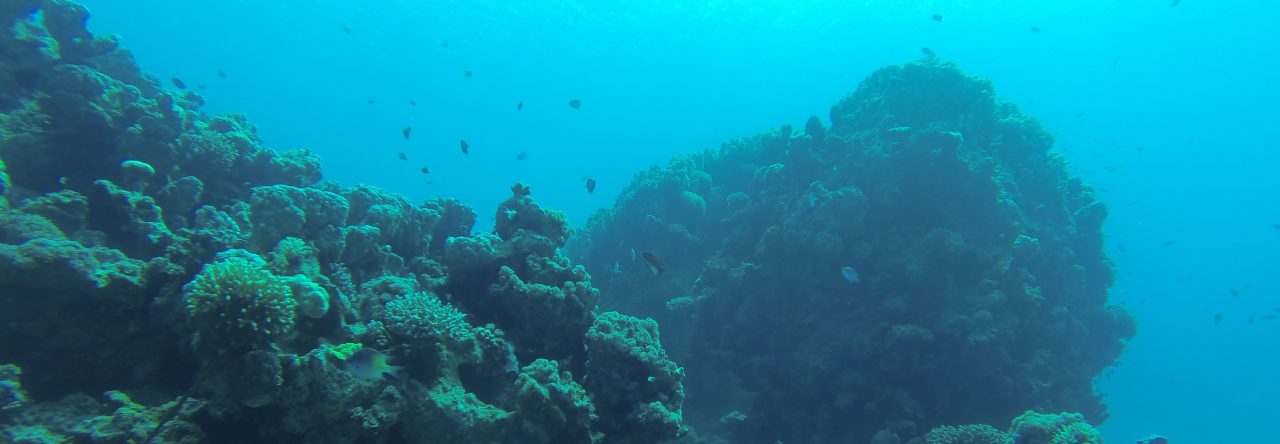
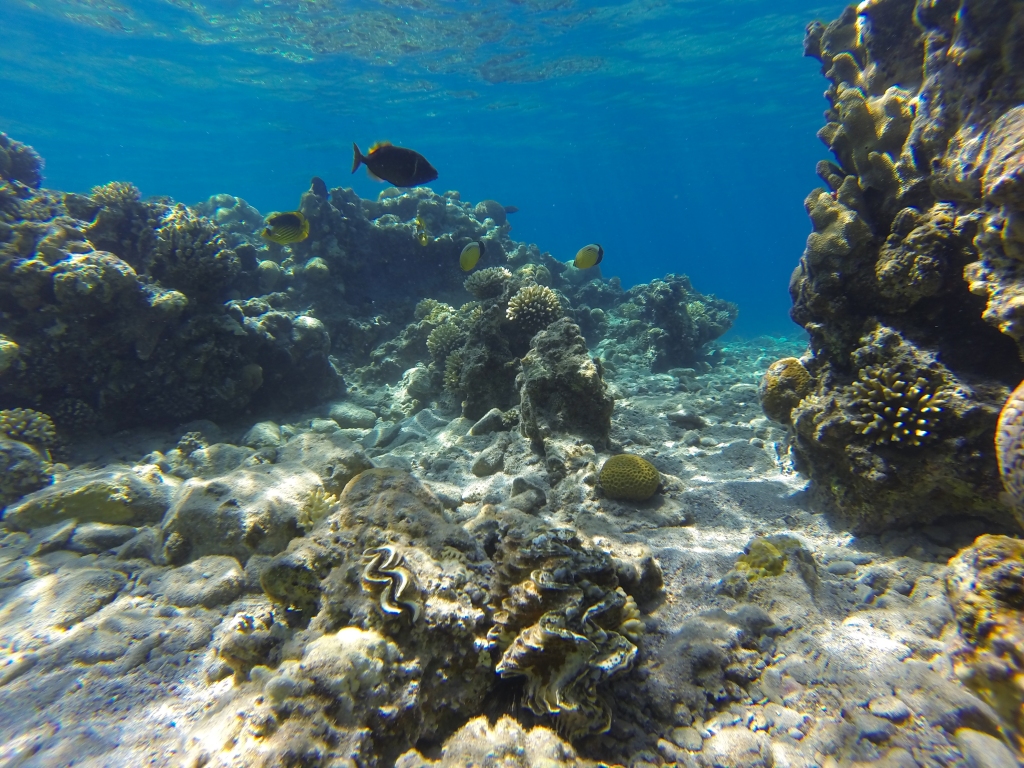
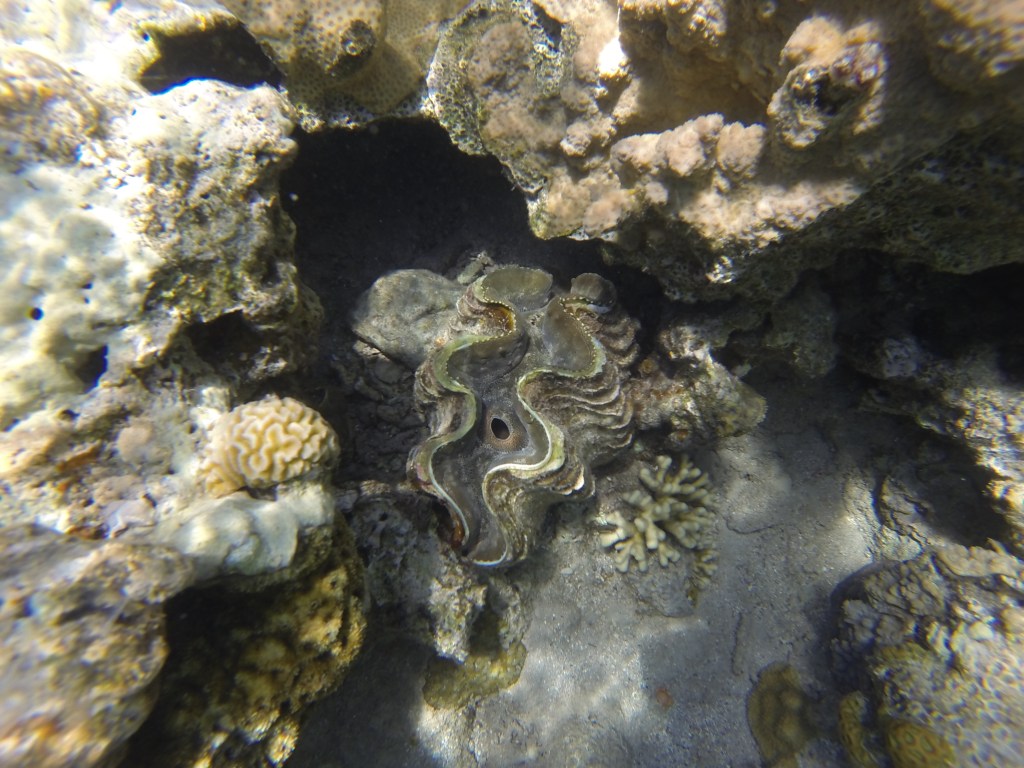
Two giant clams near Eilat in the Northern Red Sea. To the left is the small giant clam, Tridacna maxima, and to the right is a mature individual of the rare endemic giant clam Tridacna squamosina, only found in the Northern Red Sea.

You are what you eat, and clams are too. We’re made of atoms, which come in “flavors” called isotopes, relating back to the mass of the atoms themselves (how many protons and neutrons they have). Nitrogen, for example, comes in two stable (non-radioactive) forms called nitrogen-14 and nitrogen-15. Much like scientists can track the composition of a person’s diet from the isotopes of their hair, researchers have used the isotopes of clams to figure out their diet.

Nitrogen isotopes provide us with a useful and detailed record of food webs. Plants and algae tend to have more of the light isotope of nitrogen in their tissues than the animals that eat them (primary consumers), and the animals that eat those animals have even higher nitrogen isotope values. We can measure the amount of “heavy” atoms of nitrogen with a unit called δ¹⁵N (“delta 15 N”). A carnivore at the top of the food chain will have a very high δ¹⁵N, while plants will be the lowest. Clams, typically being filter feeders, will usually have an intermediate value, since they’re eating a lot of phytoplankton (tiny microscopic floating algae) and zooplankton (animal plankton that eat other plankton).

But I study a special kind of clam, the giant clams, which have a cheat code enabling them to become giant: they have algae *inside* of their bodies. The algae make food using photosynthesis and share it with their hosts! In exchange, the clams provide the algae with a stable environment free of predators, plenty of fertilizer in the form of their own waste, and even channel extra light to help the symbionts grow faster. This partnership is called photosymbiosis, and is pretty rare in clams, though it is common in other animals like the corals that build the reefs where giant clams are found! Previous researchers have shown that giant clams have very low nitrogen isotopic values in their tissue, like a plant, because they get most of their nutrition from the algae, rather than filter feeding.

I am a sclerochronologist. That means I study the hard parts of animals, in this case the shells of bivalves. Like the rings of tree, bivalves make growth lines in their shells which can serve as a diary of their lives. Some of my past work has looked at using chemistry of the growth lines of giant clams to measure the temperatures they grow at, compare the growth of ancient and modern clams, and even look at how much the clams grow in a day! Today though, I’m talking about my most recent paper, which looks at how we can use the shells of giant clams as a food diary.

But when they’re babies, the symbiosis in giant clams is not yet fully developed. During this early period of their lives, giant clams actually get more of their nutrition from filter-feeding like a “normal” non-photosymbiotic clam, until they’ve had a chance to grow in surface area and become a living solar panel. Like all bivalves, the shells of giant clams are made of calcium carbonate, bound together by a protein scaffold we call the shell organic matrix. Proteins are made of amino acids, which contain nitrogen! If we can get the nitrogen out of the shell from the early part of the clam’s life, and compare it to the nitrogen at the end of the clam’s life, it might record the clam’s transition from filter feeding to its mature plant-like lifestyle! If our hypothesis holds, we should record a decrease through its life in the shell δ¹⁵N values.
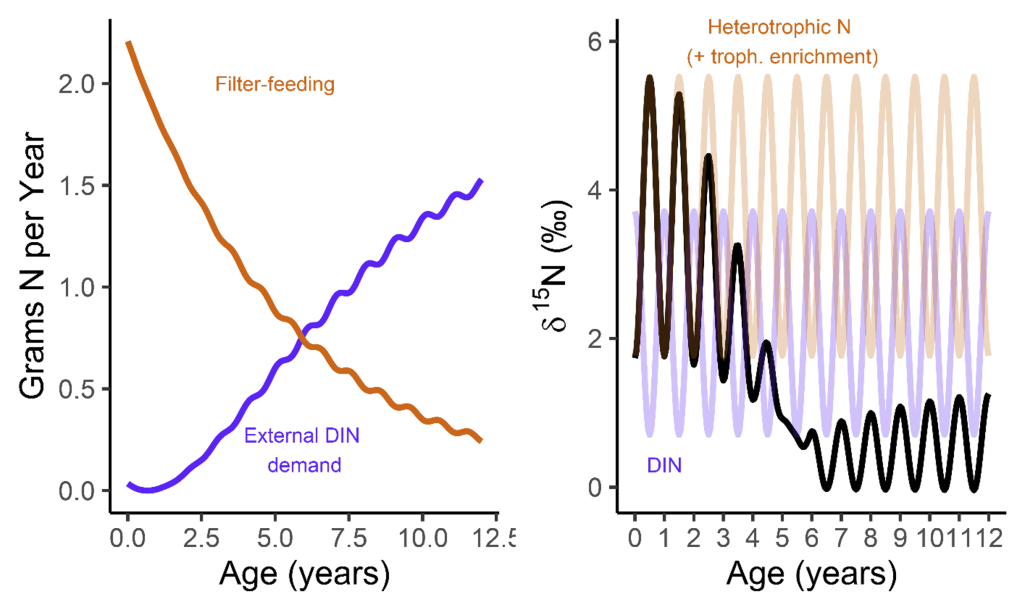
A model I made of the clams’ nitrogen intake, with the left plot how they switch from filter feeding to getting most of their nitrogen from dissolved sources around 5-6 years of age. Because the nitrogen isotopes of those two sources are different, that manifests in the expected values from the clam’s body (the right plot)!
A map made by my talented partner, Dana Shultz!

So I gathered a team of talented collaborators and set out to test that hypothesis, using giant clam shells that I was able to get on loan from the Hebrew University of Jerusalem Museum. These shells had been confiscated from poachers at the Egypt-Israel border. While I would have rather known these clams were still alive in the waters of the Northern Red Sea, being able to use them for research to understand the biology of their species was the next best thing! I had originally planned on pursuing a postdoc undertaking this project with Rowan Martindale, a professor at UT Austin who has studied the nitrogen isotopes of photosymbiotic corals, but when I started up at Biosphere 2, we ended up continuing with the project anyway as a collaboration! We measured the nitrogen isotopes of the shell material in the lab of Christopher Junium, a professor at Syracuse University, who has developed an exquisitely sensitive method to measure the nitrogen from shell material by essentially burning the shell powder and then scrubbing out unwanted material to isolate the nitrogen, to measure the isotopes in a machine called a mass spectrometer. Katelyn Gray is a specialist in isotopes of biominerals and assisted with drilling out powder from the shells with a Dremel. Shibajyoti Das, now at NOAA, is a specialist in measuring the shell nitrogen isotopes of other bivalves and he was master at doing much of the mass spectrometer work, and assisting in interpretation. Adina Paytan is a professor at UC Santa Cruz. She first provided the funding and support for me to go to the Gulf of Aqaba and collect these shells as part of an NSF-funded student research expedition! She also provided environmental data which helped us to interpret what the clams were actually eating!

A figure showing the four shells we sampled from, with the sampling areas in each hinge area showing colored and matching with the corresponding isotope plot to the right (colored points). 3 of the 4 shells show declines in isotope values with age. Shaded ribbon behind the data shows the model output.

So what did our crack team of scientists find out? We found that three of the four tested giant clams did indeed measure a decline in nitrogen isotopes over the course of their lives. Their earliest growth lines in the hinge areas of their shells record elevated δ¹⁵N values similar to other filter-feeders from the region. But as they aged, their later growth lines show much lower δ¹⁵N values, more like photosymbiotic corals and plants from the region. So clams indeed recorded the transition in nutrition as they became solar-powered! This degree and directionality of change in nitrogen isotopes was much greater than has been observed in any other clams measured in this way, which made sense considering their unique physiology. The clams have another area of the shell, the outer shell layer, which is closer to the symbionts than the hinge area. In this outer shell area, we did not observe much of a consistent trend in nitrogen isotopes. It’s likely that the outer layer is highly influenced by the photosymbionts even at the earliest stages of life.

Growth lines in the hinge area of two of the shells lit from behind, with the drilled areas for this study visible as well. The outer shell layer is the opaque and was also sampled for this study.

There was one clam that differed from the others in showing low δ¹⁵N values through life in its hinge shell layer. To help explain these differences, I created an independent model of the clams’ internal chemistry based on their growth rate, which slows as they age, and also is faster in the summer. When the clams are young filter feeders, they get most of their nitrogen from plankton, debris and other material floating in the water column making up floating material we call Particulate Organic Matter (POM). Meanwhile, when they are in their photosynthetic life stage, they get most of their nitrogen from nitrate, which is essentially Miracle Gro for the symbionts. The model showed that the clams should record a flip from filter feeding to photosynthesis around 4-5 years of age, which was confirmed by three of the shells! But what about the one that didn’t show this trend? My colleague Adina had fortunately measured the isotopes of POM and nitrate in different seasons in the Gulf of Aqaba. We found that in summer, as expected, POM δ¹⁵N is lower than nitrate. In the winter, meanwhile, that relationship is flipped! So if a clam grew more in winter, it would not record the same transition as was seen by the other clams. We think the clam that was the exception to the rule might have been more of a winter grower.

The chaotic nutrient environment of the Northern Red Sea, showing how in different seasons, dissolved nitrate has higher or lower δ¹⁵N values than the Particulate Organic Matter that the clams filter-feed on.

But long story short, we were able to demonstrate for the first time that giant clams show nitrogen isotopic values in their shells in line with expectations from their diet. Other clams have been measured this way, but the fact that we were able to conduct these analyses at all is a testament to the sensitivity of the elemental analyzer in Chris’s lab. Giant clams have *very* low concentrations of organic matter in their shells, so the forward march of technology was a major factor enabling this study to be possible.

Why does it matter that we can measure the transition of the clams from filter-feeding to photosymbiotic in their shell records? Well, giant clams are not the only bivalves which have photosymbionts. There are other clams in the fossil record which have been proposed to have had symbioses with algae, but until now we’ve never had a definitive geochemical way to measure this in fossils. We hope that this approach can be applied to the organic material in fossil shells, which is often well preserved, to see if huge clams in the Cretaceous and Jurassic had a similar way of life to the modern giant clams! If we can demonstrate that was the case, we can see how such species responded to past intervals of climate change, which will help us understand how giant clams will fare in the warming, acidifying ocean of the present.

These results also help explain the lives of giant clams themselves. We hope this kind of data can be used to measure the symbiotic development of giant clams in different places, with different types of food and nitrogen available, where we’d have the potential to measure pollution. Interestingly, the time that the model shows the clams transitioning to photosynthetic maturity is right around the time that they reach reproductive maturity (5-10 years of age). We’d like to investigate whether the time of clam maturity is controlled by the development of their symbiosis, which itself might relate to nutrients in the clams’ environment. If clams can grow faster, then they can mature faster, and potentially reproduce sooner in life. Will giant clams be able to thrive in the presence of increased nitrate, which is a common pollutant in coral reef environments? Like all worthwhile research projects, we have dozens of new questions to pursue as a result of this work, so stay tuned for the next installment in this journey of clam knowledge!

Research Explainer: How I learned to stop worrying and trust the clams

Two giant clams off the coast of Israel. Left: Tridacna maxima, the small giant clam. Right: Tridacna squamosina

Another year, another new paper is out, another clamsplainer to write! The fourth chapter from my PhD thesis was just published in Proceedings of the Royal Society B. This study represents five years of work, so it feels great to finally have it leave the nest. In this study, we investigated the comparative growth of fossil and modern giant clams in the Gulf of Aqaba, Northern Red Sea. Back in 2016 during my PhD, I knew I wanted to study giant clams because they are unique “hypercalcifying” bivalves that grow to huge sizes with the help of symbiotic algae living in their bodies. The clams are essentially solar-powered, and use the same type of algae that reef-building corals depend on! Unlike corals, which are the subject of a ton of research related to how they are threatened by climate change, habitat destruction and pollution, comparatively little is known of how giant clams will fare in the face of these environmental changes. Are they more resistant than corals, or more vulnerable?

T. squamosa on the reef off the coast of Eilat.

I had strong reason to suspect that the clams are struggling in the face of human changes to the environment. They can bleach like corals do when exposed to warm water, and have been observed to be harmed when waters are less clear since they are so reliant on bright sunlight to make their food. But I need a way to prove whether that was the case for the Red Sea. I needed to travel to a place where fossil and modern giant clams could be found side by side, so their growth could be compared using sclerochronology. We would count growth lines in their shells to figure out how fast the grandaddy clams grew before humans were around, and compare that ancient baseline to the growth rate of the clams in the present. Giant clams make growth lines every day in their shells, giving us the page numbers in their diary so we can figure out exactly how fast they grew! We can also measure the chemistry of their shells to figure out the temperatures they experienced from the oxygen isotopes, and even what they were eating from the nitrogen isotopes.

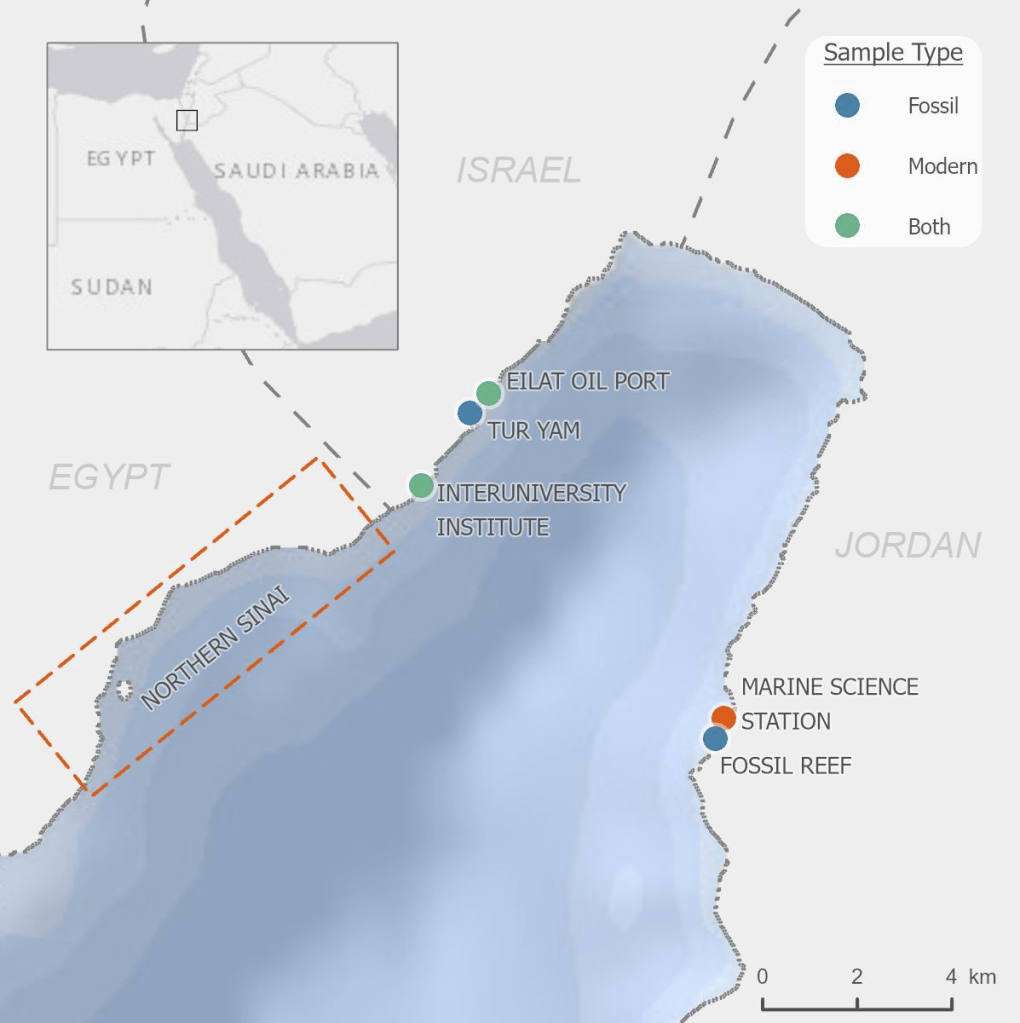
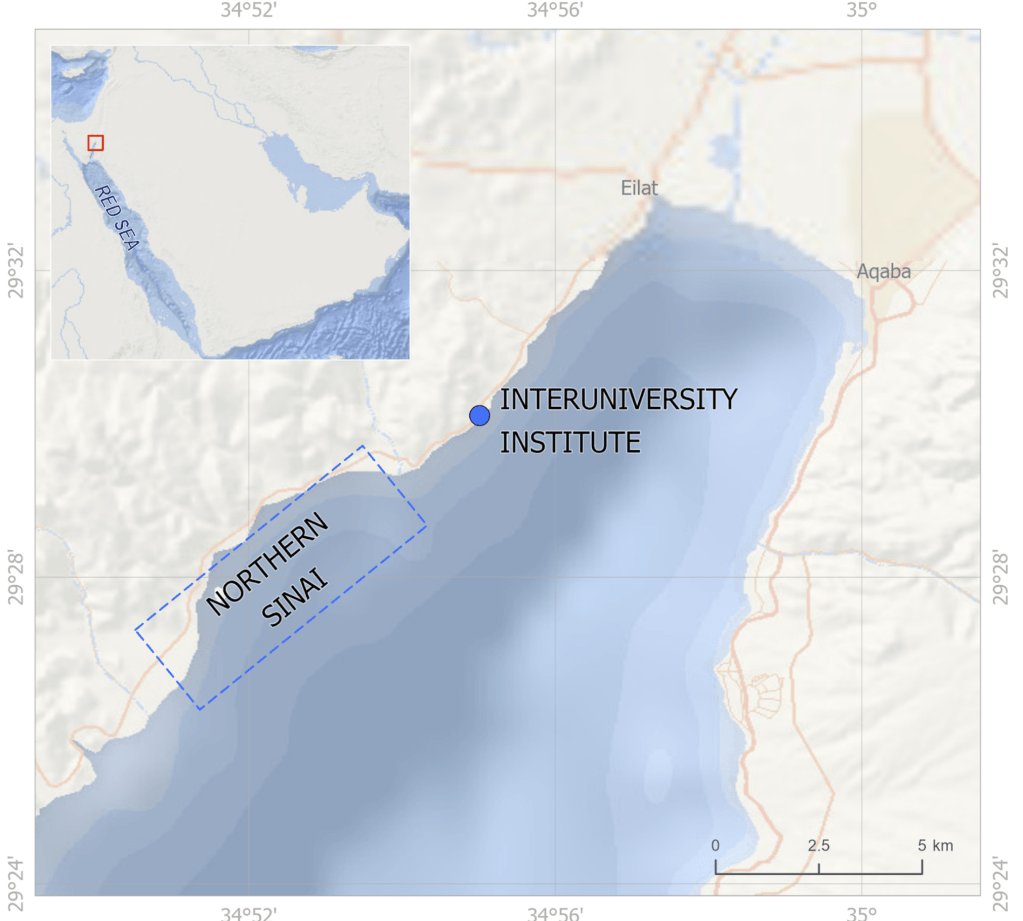
A map of the Gulf of Aqaba, where our study took place. My talented marine scientist partner Dana Shultz made this map!

It just so happened that UCSC’s Dr. Adina Paytan was leading an NSF-funded expedition to the Red Sea in summer 2016, which represented a perfect place to do this work. There are many age dated fossil reefs uplifted onto land around the Gulf of Aqaba on the coasts of Israel and Jordan, and there are three species of giant clam living in the Red Sea today: Tridacna maxima (the small giant clam), Tridacna squamosa (the fluted giant clam), and Tridacna squamosina. Tridacna squamosina is particularly special because it is only found in the Red Sea, making it an endemic species. It is extremely rare in the modern day, with likely only dozens of individuals left, making it potentially endangered.

So I set off with Adina and two other students to live for two months in in the blazing hot desert resort town of Eilat, Israel, working at the famous Interuniversity Institute. Getting a permit from the Israeli National Parks Authority, I collected dozens of empty giant clam shells (no clams were harmed in the course of this study!) from the surf zone and from ancient reefs ranging from a few thousand years to almost 180,000 years old. I also spent a week over the border in Aqaba, Jordan where I worked with Dr. Tariq Al-Najjar, my coauthor and director of the University of Jordan Marine Science Station. Tariq is a specialist in algal productivity in the Gulf and was an excellent resource in trying to understand how water quality has changed in the area through time. He pointed out that over the years, the Gulf of Aqaba has had an increased nutrient supply far above what it received in historic times. For nearly 20 years the Gulf was subjected to excess nutrients from Israeli fish farms, which caused tremendous damage to the reefs of the area with their releases of fish waste. The farms were finally forced to close after a long lobbying campaign from Israeli and Jordanian scientists and environmentalists. But even after the farm pollution stopped, there was still increased nutrient supply from runoff and even carried into the Red Sea by dust in the form of nitrate aerosols. These aerosols are produced when our cars and power plants release nitrogen oxide gases, which react in the atmosphere to form nitrate and fall during periodic dust storms that hit the Red Sea a few times per year.

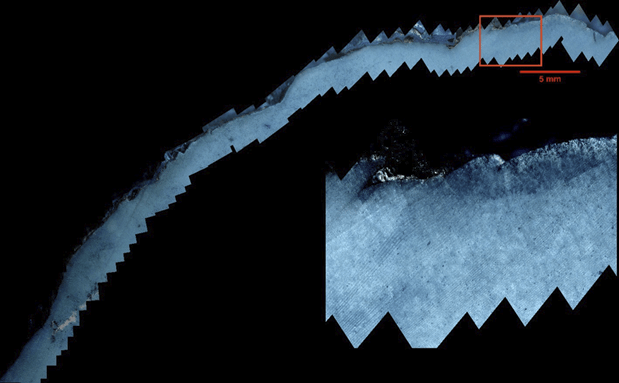
All of these sources of nitrogen are fertilizer for plankton, causing what scientists call “eutrophication.” When plankton blooms, it literally causes the water to be less transparent, which could reduce the clams’ ability to gather light and lead to them growing more slowly. At least that was my hypothesis, but I had to prove if it was true or not. So during that summer and over the next few months, I cut dozens of clam shells into cross-sections, used a special blue dye called Mutvei solution to make their growth lines visible, and took pictures of those lines with a microscope. Then I counted those lines to figure out how many micrometers the clam was growing per day.

A picture showing some of the fine daily lines visible in a blue-stained shell

Here I hit my first challenge: it turned out some clams were putting down one line per day as expected, but some were putting down twice as many! But the way I was using to discern between the two was to measure the oxygen isotopes of the clams’ shells, which forms a record of temperature. By counting how many lines appear between each annual peak of temperature, we confirmed some were daily and some were twice daily. But the oxygen isotope approach is expensive would not be scalable across the dozens of shells I had collected.

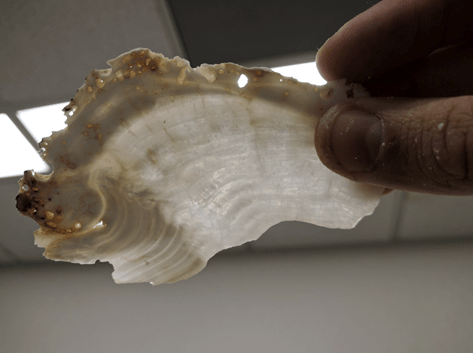
Annual growth lines in the shell of a Tridacna maxima clam

Then I remembered that I could measure the lines in the inner part of the clams’ shells, which are formed annually. By counting those lines and then measuring the length of the clam, I could get an approximate measure of how much it grew per year on average. This would allow me to calibrate my band-counting and discern which records represented daily lines and which were twice daily! What a relief.

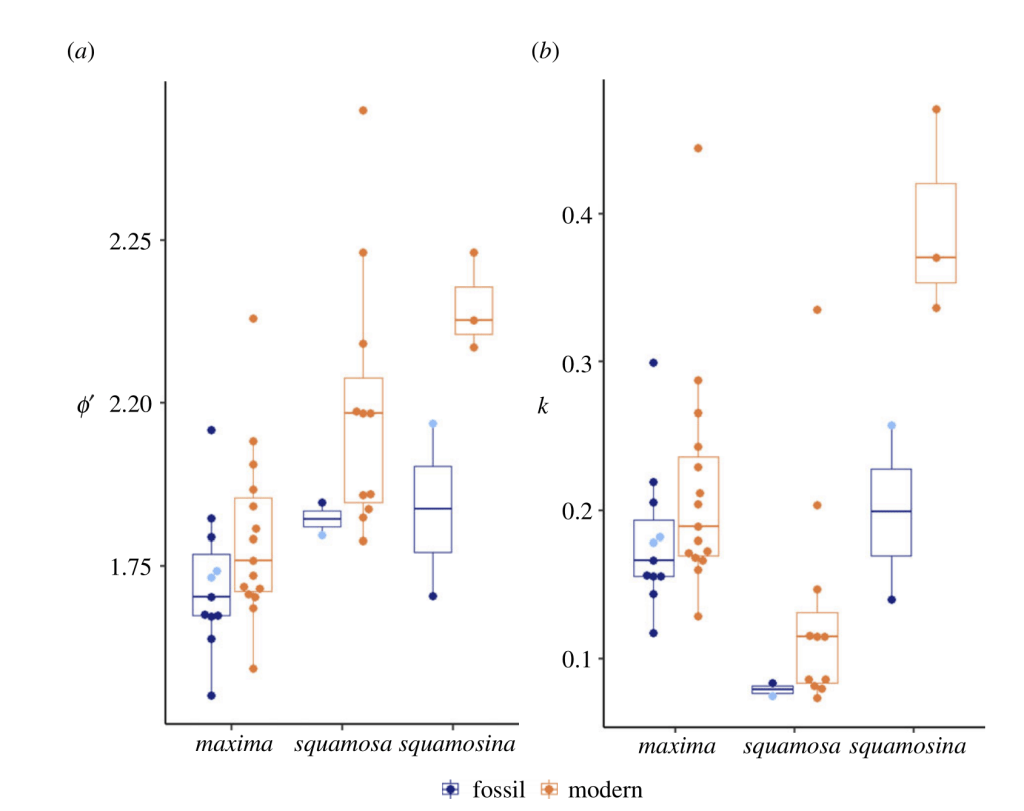
So I went through all of the shells, counting lines and gathering growth info for as many shells as I could muster. It meant many hours staring at a microscope, taking pictures and stitching the pictures together, then squinting at my computer screen highlighting and measuring the distance between each growth line. I had hoped to come up with an automated way to measure it, but the lines turned out to be faint and difficult for the computer to distinguish in a numerical way. So instead I just powered through manually. When I had the raw growth data, I then transformed them to a pair of growth constants commonly used in the fisheries literature to compare growth across populations. When I put the data together across all 55 shells, I was surprised to discover that my hypothesis was totally incorrect. The clams were growing faster!

Growth constants for all three species, comparing fossils and modern shells. We used two growth constants (phi prime and k) to help control for the fact that our clams were at different sizes from each other. You wouldn’t compare the growth rate of babies and teenagers and try to make any broader assumptions of their relative nutrition without some additional attempts to normalize the data!

Science rarely goes according to plan. The natural world is too complex for us to follow our hunches in understanding it, which is the main reason the scientific method came about! But at a human level, it can still be shocking to realize your data says you were totally wrong. So after a few days sitting and ruminating on these results and what they meant, I remembered what Tariq and other scientists had said about nitrates. The clams are essentially part plant. They use photosynthetic symbionts to gain most of their energy. And much as nitrate pollution can fertilize plankton algae growth, maybe it could do the same for the algae within the clams! It had previously been observed that captive giant clams grew faster when “fertilized” with nitrates or ammonia. But such an effect had never before been observed in the wild. We needed a way to demonstrate whether the Red Sea clams were experiencing this.

Fortunately, the clams also keep a chemical record of what they’re eating within the organic content of their shells. Shells are a biological mineral, made of crystals of a mineral called calcium carbonate. But within and between those crystals, there’s a network of proteins the clam uses like a scaffold to build its shell. Those proteins are made of amino acids that contain nitrogen. That nitrogen comes in different “flavors” called isotopes that can tell us a lot about what an animal eats and how it lives. The ratio of heavier nitrogen-13 and lighter nitrogen-12 increases as you go up the food chain. Plants and other autotrophs have the lowest nitrogen isotope values because they use nitrate directly from the environment. For every level of the animal food chain, nitrogen isotope values increase. Herbivores are lower than carnivores. If you live on only steak, your nitrogen isotope values will be higher than a vegetarian. The same will be true for clams. If the clams were taking in more nitrogen from sources like sewage or fish farms, they would show higher nitrogen isotope values in the modern day.

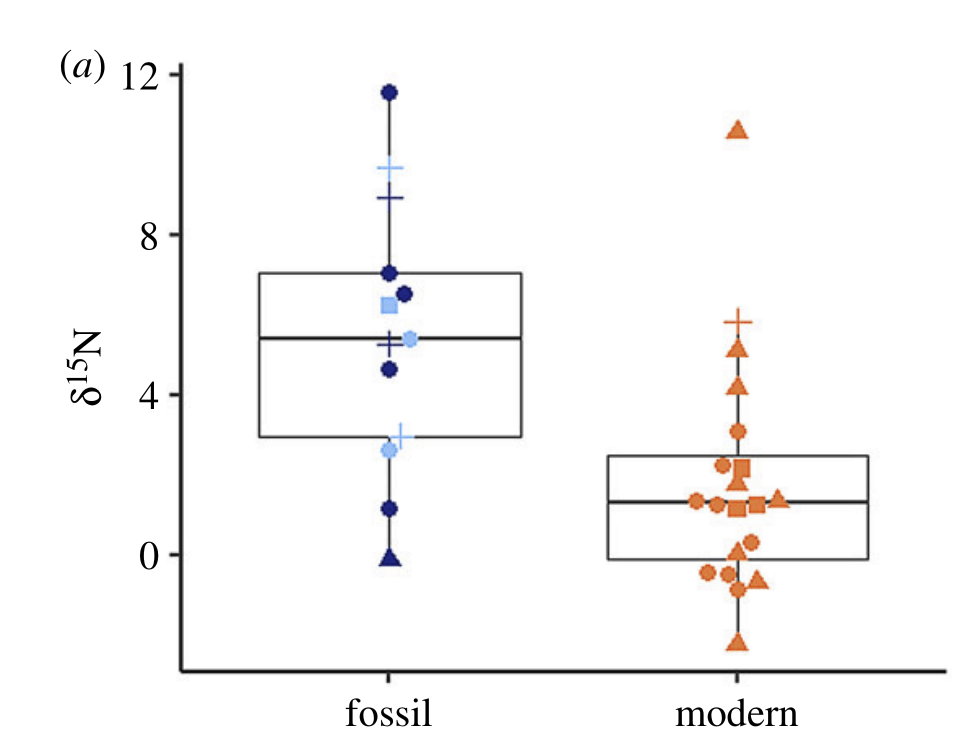
We found that nitrogen isotope values were lower in the modern day!

Taking bits of powder from several dozen of the shells, we worked with technician Colin Carney at the UCSC Stable Isotope Lab to measure the nitrogen isotopes of the shell material. A machine called an Elemental Analyzer literally burns the shell material to release it in a gas form. A carbon dioxide scrubber absorbs the CO2 and carbon monoxide gas, leaving only the nitrogen gas behind. That gas is measured by a mass spectrometer, which essentially separates out the different isotopes of nitrogen and tells us what fraction is nitrogen-13 or nitrogen-12. Plotting all the shell data together, I discovered that my hypothesis was…totally wrong. The nitrogen isotope values of the modern shells were lower than the fossils. The clams had moved down in the food chain, but how?

https://www.israelscienceinfo.com/wp-content/uploads/2017/09/timna-park.jpg
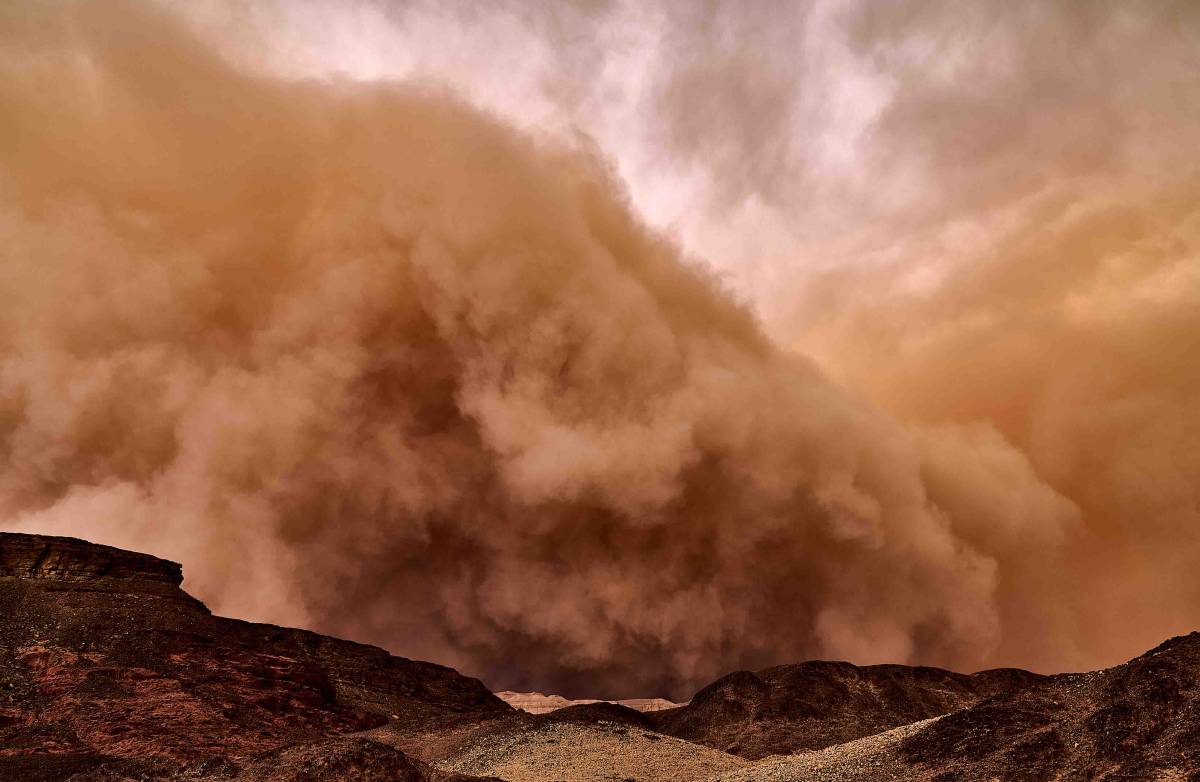
A dust storm rolling over the Israeli Negev Desert. Source

After ruling out a bunch of other explanations including the preservation of the shells, we propose that this represents a human-related change in the environment that the clams are recording. As I mentioned before, the Red Sea these days is regularly hit by huge dust storms which are conduits for nitrate aerosols. Our cars emit nitrogen-containing gases which, through a complex web of chemical reactions in the atmosphere, end up in the form of nitrate particles called aerosols. These nitrate aerosols bind to the dust delivered by strong windstorms called haboobs, which carry the dust long distances, with some of it being deposited several times of year. This deposition of nitrate has been found to form up to a third of the nitrate supply hitting the Red Sea, and was a source of nitrogen that wasn’t available to the clams in historic times. These nitrate aerosols are extremely low in nitrogen isotope value, and would be very likely to explain the lower nitrogen isotope value in our clams! If the clams ate the nitrate, their symbionts would grow more quickly, providing them with more sugars through photosynthesis and accelerating clam growth!

Some additional factors probably also have influenced giant clam growth in the region. The Red Sea historically had regular monsoon rains which likely slowed growth in fossil clams, as storms are known to do for giant clams in other areas, but such monsoons no longer reach the area. The Red Sea also had much higher seasonal range of temperatures in the past, with colder winters and warmer summers. Both factors (storms and extremes of temperature) have been previously shown to depress giant clam growth, and so the modern Red Sea may be a goldilocks environment for the clams: a consistent year-round not too cold or hot temperature.

However, as we discuss in the paper, these factors don’t necessarily mean that the clams are healthier. Faster giant clam growth has been found in other research to lead to more disordered microstructure in their shells, which would have uncertain effects on their survival against predators like fish, lobsters and humans. Additionally, a higher nutrient supply to reefs often causes the corals that build the reefs to lose out to competition from algae that block sunlight and crowd out coral colonies. If the reefs are harmed by the climatic changes that have potentially helped the clams, the clams will still lose. Giant clams are adapted to live only where coral reefs are found, and nowhere else. So more research will be needed in the Red Sea to determine if the health of clams and corals is hurt or harmed by these nitrate aerosols, and what that will mean for their long-term survival in the area.

Over the course of working on this research, the giant clams taught me a lot about life. They taught me that my hypotheses are often wrong, but that’s alright, because my hypotheses can still be wrong in a way that is interesting. I learned to go with the flow and trust the clams to tell me their story through the diaries they keep in their shells. I have followed their lessons wherever they led. Now I am doing follow-up work growing giant clams in a giant coral reef tank at Biosphere 2 in Arizona, to directly observe how the clams’ symbiosis develops and create new forms of chemical records of their symbiosis! The work described in my paper here has led to a suite of different ongoing projects. The clams have many more lessons to teach me. Thank you clams!

The Mystery of the Giant Clams of the Red Sea and Indian Ocean

I have always been fascinated by scientific discoveries that are hanging right in front of our noses. Cryptic species are one such surprise. Sometimes, researchers using genetic sequencing are surprised to discover that a group of animals that all look the same from the outside are actually reproductively isolated from each other; separate twigs on the tree of life. This surprise has happened over and over in the history of natural science.

It turns out such puzzles are frequent among the giant clams. These unusual bivalves are specialists in coral reef environments, growing to large size with the help of symbiotic algae that create sugars through photosynthesis. Within the genus Tridacna there are ~10 accepted species which vary in size, shape, color and mode of life.

Tridacna squamosina (right) sitting next to the small giant clam T. maxima (left) on the Israeli Red Sea coast

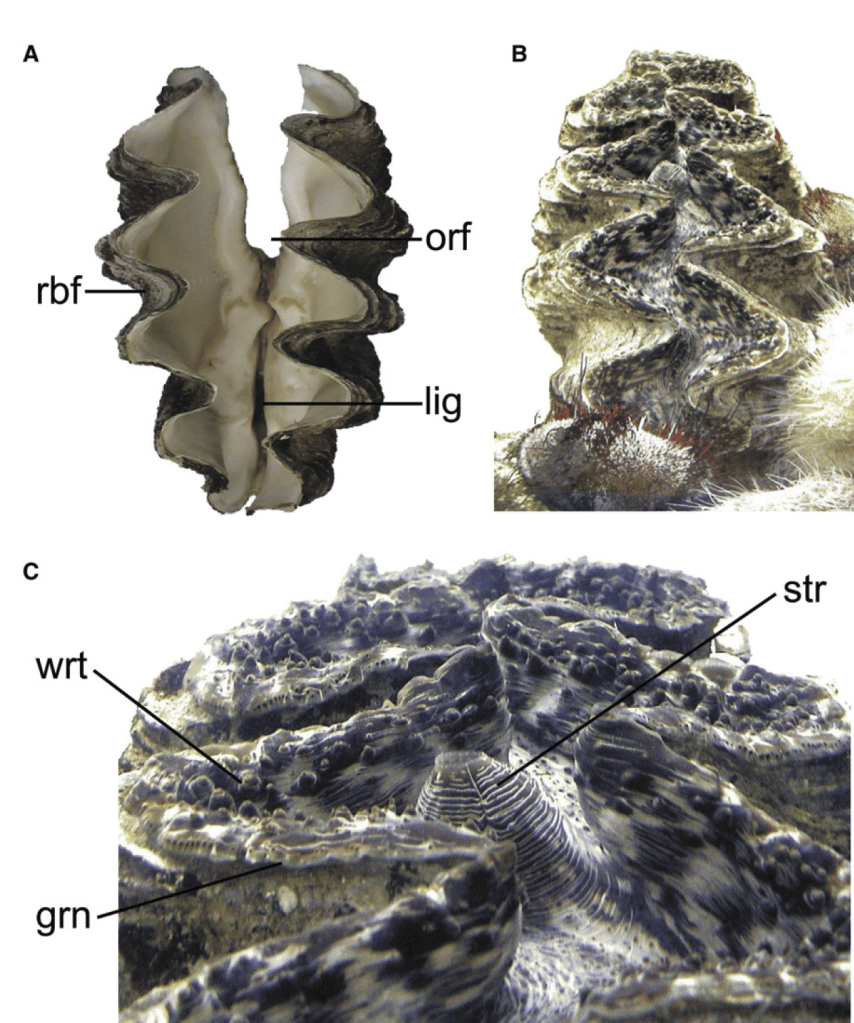
I specialize in the three species known (so far) from the Red Sea, including the small giant clam Tridacna maxima and the fluted giant clam T. squamosa, which are both found worldwide, all the way from the Red Sea to down past the equator along the Great Barrier Reef. The third local species, T. squamosina is more unusual, so far being only known from the Red Sea (an endemic species). T. squamosina is an example of a cryptic species, having previously been assumed to be a local variant of T. squamosa. It looks pretty similar, with long scutes (flap-like appendages) protruding from its shell, thought to help stabilize it on the flat bottom of loose coral rubble. But unlike T. squamosa, T. squamosina lives exclusively at the top of the reef in the shallowest waters closest to the sun. It has a very angular, zig-zag pattern in its plications (the wavy shapes at the edge of the shell) and a characteristic pair of green stripes where the soft tissue meets the edges of the shell. The soft tissue is covered with warty protuberances.

Pictures of details of T. squamosina from Richter et al. 2008

It was only first described in detail in the early 2000s, when an international team of researchers figured out using genetic sequencing that it was a distinct species and named it T. costata. They noted that in their surveys all around the shores of the Red Sea, they only found 13 live specimens, making it an extremely rare and possibly endangered species. Fossil specimens on local reefs appeared to be much more common, suggesting it had a much larger population in the past. Then in 2011, another team at the Natural History Museum in Vienna discovered a shell of one had been forgotten in its collection for over 100 years. Rudolf Sturany, the researcher on the 1895 research cruise who had originally collected the clam, had called it T. squamosina.

The T. squamosina shell in the collection of the Museum of Natural History in Vienna (from Huber and Eschner, 2011)

In taxonomy (the science of naming and classifying organisms), the first team to name the species wins, so the name T. costata was synonymized (retired) in favor of the earlier name T. squamosina, which became the name of record. It must be annoying to spend so much time working to name a species and then discover you had been scooped over a century before! But such is science.

A mystery clam thought to be T. squamosina, later identified as T. elongatissima found off of Mozambique by iNaturalist user bewambay

The strange part was that there were some murmurs over the last few years that T. squamosina was not only found in the Red Sea, but also had been seen along the coast of Africa as far south as Kenya, Mozambique and Madagascar. Divers and snorkelers had taken pictures of a giant clam that did indeed look strangely like T. squamosina, with a zigzag shell opening and green stripes at the edge of its tissue. But some aspects of these individuals seemed off. In the Red Sea, T. squamosina lives freely, not embedded in the coral as these pictures showed, and the geometry of the angles of the shell seemed a bit different. It also would be difficult for T. squamosina to be connected in population from the Red Sea all the way South to Mozambique, as there are natural barriers which would prevent its planktonic larvae from riding currents to intermix between the two regions. When populations are separated by a barrier, the flow of genes between them is cut off and evolution begins to separate the populations from each other until they are separate species, a process called allopatric speciation.

A large specimen of T. elongatissima observed by iNaturalist user dawngoebbels off of Kenya

I figured that someday, researchers would collect tissue samples from these mystery clams to settle whether they were actually T. squamosina or something else. And this year, a team did just that, traveling along the coast of Mozambique, Madagascar, Kenya and other places, collecting samples of tissue to compare how all the different clams they saw were related in a family tree. They genetically sequenced these “clamples” and in the process, found that the mystery clams were a new cryptic species, which they called T. elongatissima!

Shells of T. elongatissima from the Fauvelot et al. 2020 paper
For comparison, a shell of T. squamosina collected off of Sinai, Egypt. You can see why they’re easy to mix up!

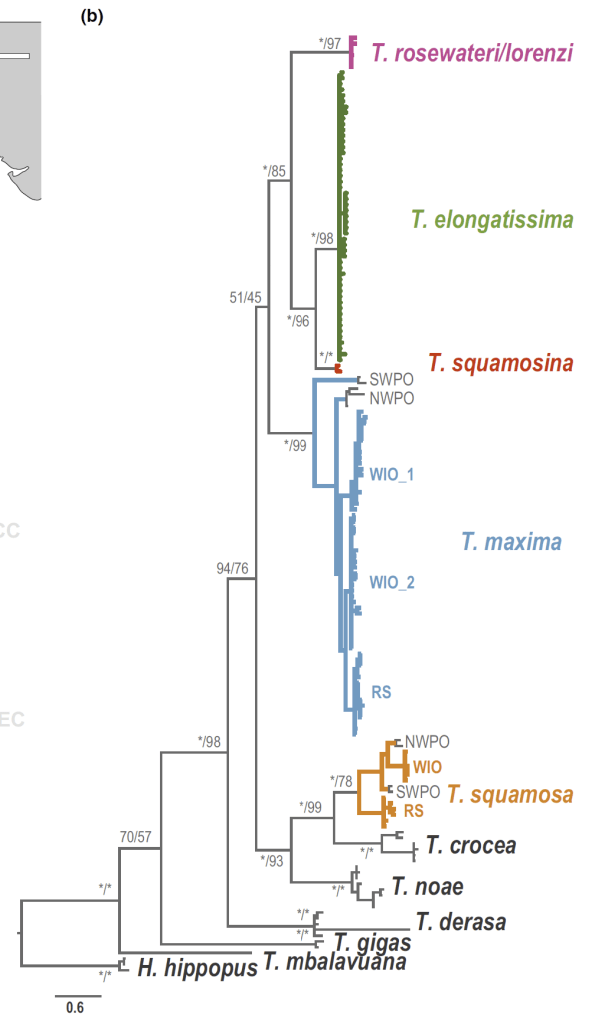
T. elongatissima closely resembles T. squamosina, and they are sister species on the bivalve family tree. It’s hard to tell them apart without training. Even a professional would probably mix some of them up if they were all placed sitting next to each other. The major differences appear to relate to shell shape, with T. elongatissima having a less symmetrical shell than T. squamosina, and a bigger opening at the rear hinge for a foot to poke through. The symmetrical shell and closing of the foot opening may represent changes that T. squamosina took on to adapt to be able to sit freely on the bottom, rather than embedding in the coral like T. elongatissima seems to prefer. If you’ve read this far, you may be thinking “Who cares? A clam’s a clam and these look practically the same. Aren’t you just splitting clams at this point?” At the end of the day, a species is a man-made concept; an organizing tool for use by us humans. Species are the characters in our reconstruction of the history of the world. What can we learn about the world by having identified this species T. elongatissima?

A giant clam family tree! Notice T. squamosina and T. elongatissima right next to each other.

The researchers behind the new paper discuss that based on statistical analyses of the genetic differences between the species, the most recent common ancestor for T. elongatissima and T. squamosina probably lived more than 1.4 million years ago! Some researchers have previously suggested that T. squamosina probably began its development as a separate species due to geographic isolation by low sea level, caused by repeated glaciations. With so much water trapped as ice on land during this period, the narrow Strait of Bab al Mandab, currently the gateway to the Red Sea, became a land barrier as sea level fell (kind of like opposite of the Bering Sea land bridge that formed allowing humans to migrate to the Americas). Ancestral clams trapped on the Northern end of this barrier were proposed to have evolved to become the rare T. squamosina.

This has occurred with a variety of species that became Red Sea endemics (meaning they are unique species that evolved in the Red Sea and are found nowhere else), including a unique crown of thorns starfish. The issue is that during this time of low sea level, the Red Sea went through periods where it was a rather unfriendly place for clams to live. All sorts of creatures went extinct in the period when the sea was repeatedly cut off, because the water became extremely salty, along with other unfriendly changes. So it’s unlikely T. squamosina would be present for us to see today if it only lived in the Red Sea throughout the entire length of time.

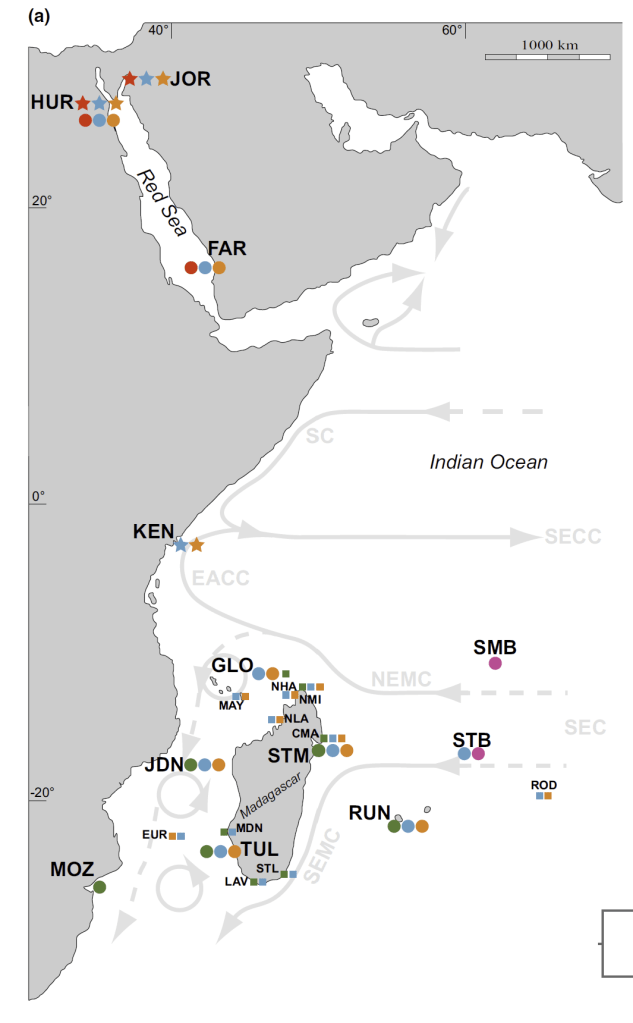
A map from Fauvelot et al. 2020 showing the distributions of different giant clams the researchers identified along the coasts of Africa and the Red Sea. Notice the bright red dots representing T. squamosina, only found in the Red Sea, while green dots represent T. elongatissima. Notice how the currents (arrows) seem to meet and then go offshore from Kenya. More on that in the next paragraph.

The researchers of this new paper propose that T. squamosina was more likely to have initially branched off due to the barrier of the Horn of Africa. The seas off of Kenya and Somalia harbor a meeting of southward and northward currents which then group and head offshore, away from the reefs that giant clam larvae are trying to get to. So any tiny floating planktonic clam larvae would experience a strong “headwind” preventing them from crossing that point. It would also mean that during times that the Red Sea was not a happy place to be a clam, T. squamosina may have found refuge on the coasts of places like Eritrea, Oman and possibly even as far as Pakistan. During times when sea levels rose and Red Sea conditions became friendlier, it recolonized the area.

As far as we know, the Red Sea is the only place T. squamosina is now found, but it may well be present elsewhere like Yemen or Oman. If T. squamosina was found in other regions, it would be tremendously important for its conservation. Right now, the species is thought to be extremely rare, with a very small native range. If it inhabited a broader area, that would mean more reservoirs of genetic diversity. This would reduce the odds that it will go extinct as reefs are put under stress from climate change, pollution and overharvesting. To survive as a species, it helps to not put all your eggs in one basket. If you’re only found in one small place, it increases the chances that a disaster (like climate change) will wipe you out.

The only way we will know for sure is to visit reefs in understudied places like Yemen, Oman, Pakistan, Eritrea and Somalia, to understand the richness of the giant clams present. These areas are understudied for various reasons: lack of research funding for non-Western researchers, lack of interest from the scientific community too focused on familiar places, and geopolitical situations that make it difficult to conduct research. But I hope someday to collaborate with people in these countries to better understand the giant clams present in such understudied regions of the globe. It is virtually certain that there are more species of giant clams, both alive and as fossils, waiting to be discovered.