How Golden Mussels are conquering the Golden State

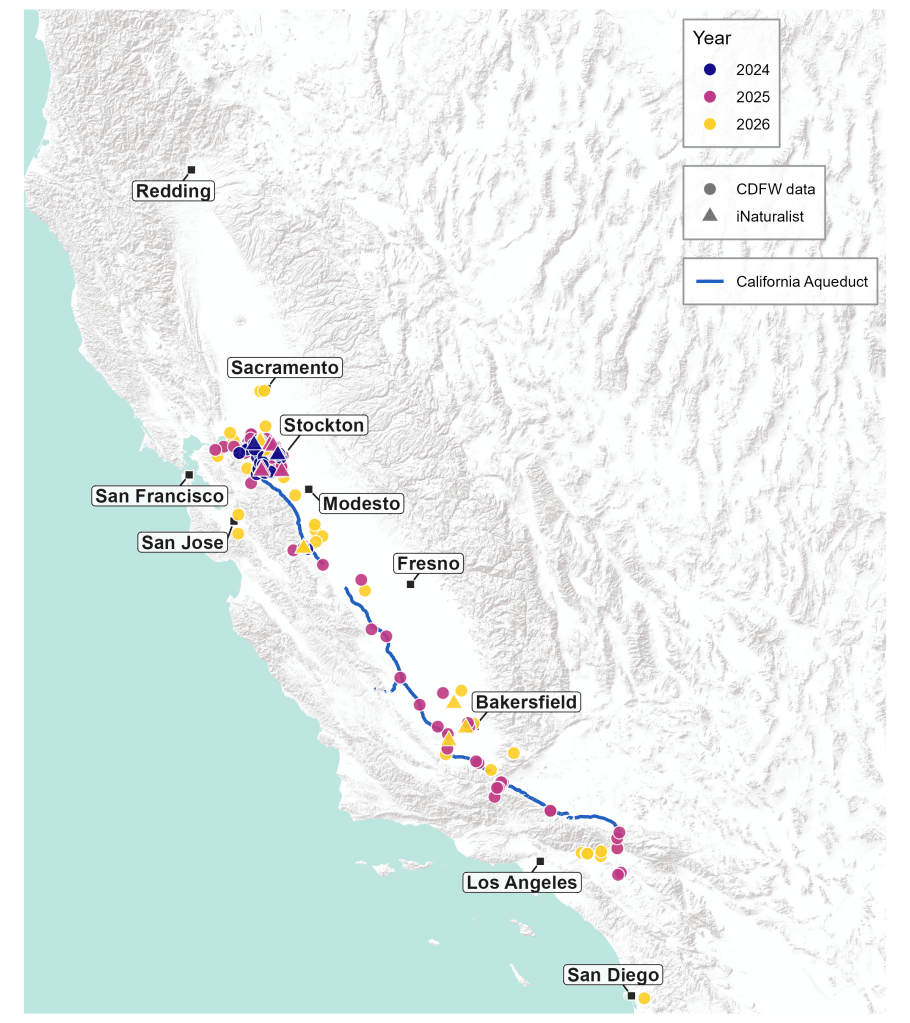
Map of golden mussel observations through time. Data sources: CDFW and iNaturalist

Since its initial appearance in California in October 2024, the golden mussel, Limnoperna fortunei, has accomplished Big Things. These little mussels, native to the Pearl River Delta in China, have taken off from their initial foothold in Stockton to spread all the way south to San Diego, and have been spreading northward as well in recent months. It has been an extreme couple years for CA invasion science!
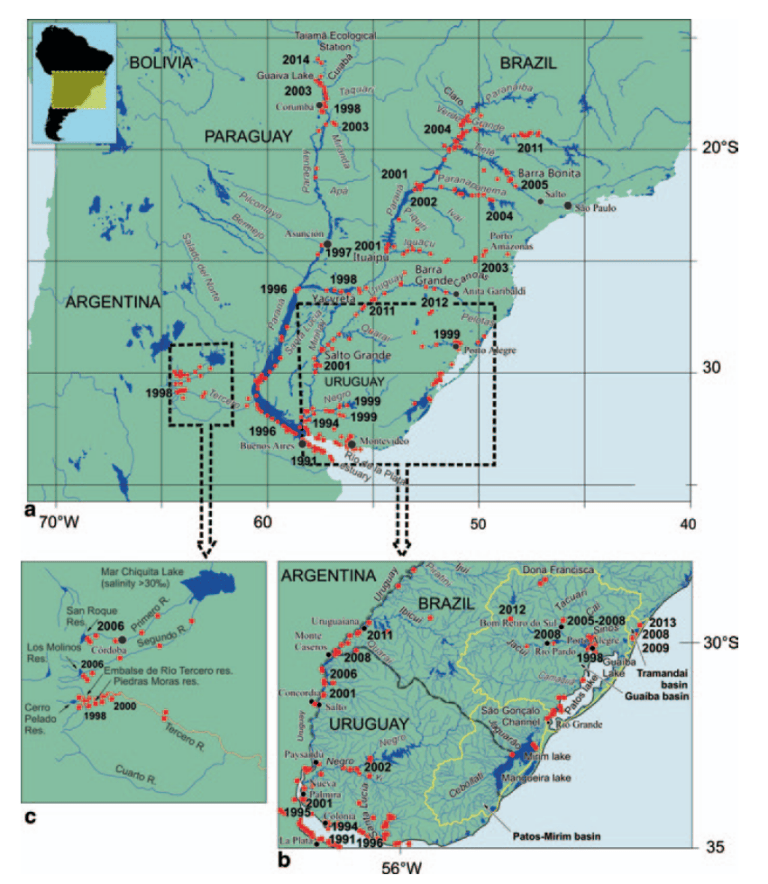
A map of their appearances and spread through South America. Source

As I described in my previous blog, golden mussels have spread from China to Japan, Argentina, and Brazil before appearing here. Previous researchers noted that California represented a great environment for them to settle, with conditions pretty similar to the Rio De La Plata Estuary in Argentina and Uruguay, where they first invaded South America in 1991, spreading up through the rivers attached to ships until they reached Brazil. More recently, they have reached the edges of the Amazon.
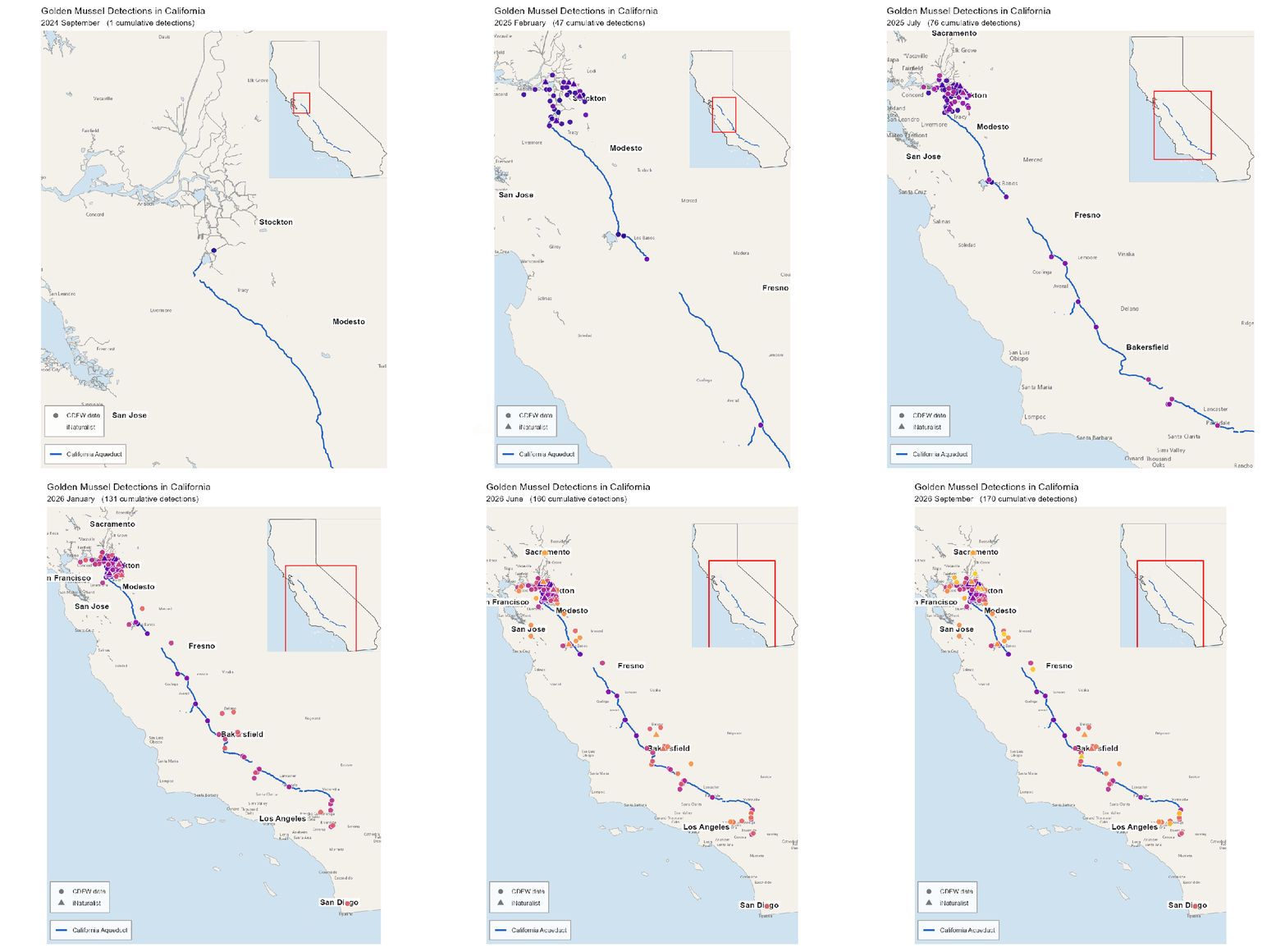
An animation zooming out across California as the mussels have spread. Each frame of the animation is one month The blue line shows the path of the CA Aqueduct. Purple dots are older while red and yellow dots are newer. Data sources: CDFW and iNaturalist

But the rate of spread in California has been faster than in South America, because of the transport provided by the California Aqueduct. Data collected by California Department of Fish and Wildlife tell the story. Mussels were first observed near Stockton in September and October 2024, likely brought in the ballast water of a ship traveling from one of the regions they’ve already invaded. They quickly distributed over the following months through neighboring areas of the Delta, probably mostly from the tidal flow carrying their larvae. Researchers at Contra Costa Water District began to observe them on their settlement plates that they used to monitor for zebra mussels in their reservoirs. The mussel larvae then were observed near Tracy in November, where the main pumps leading into the California Aqueduct are located. Even before that, they had been observed at the San Luis Reservoir far down the aqueduct in October. Over the following months in 2025, the mussels were free to head down the entire aqueduct, piped directly to Southern California. Along the way, they were sucked into various reservoirs connected to the Aqueduct, such as San Luis Reservoir, Pyramid Lake and even reservoirs in San Bernadino. By early 2026, they were observed at the Sweetwater Reservoir in San Diego County (which also has water sourced from the California Aqueduct).
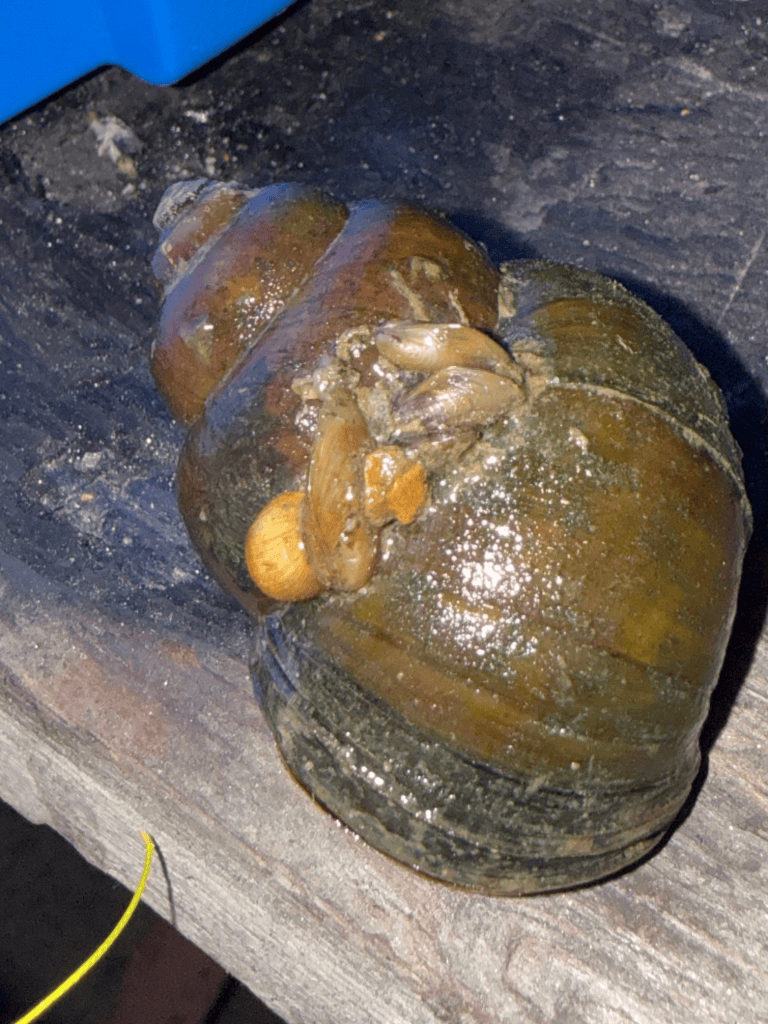
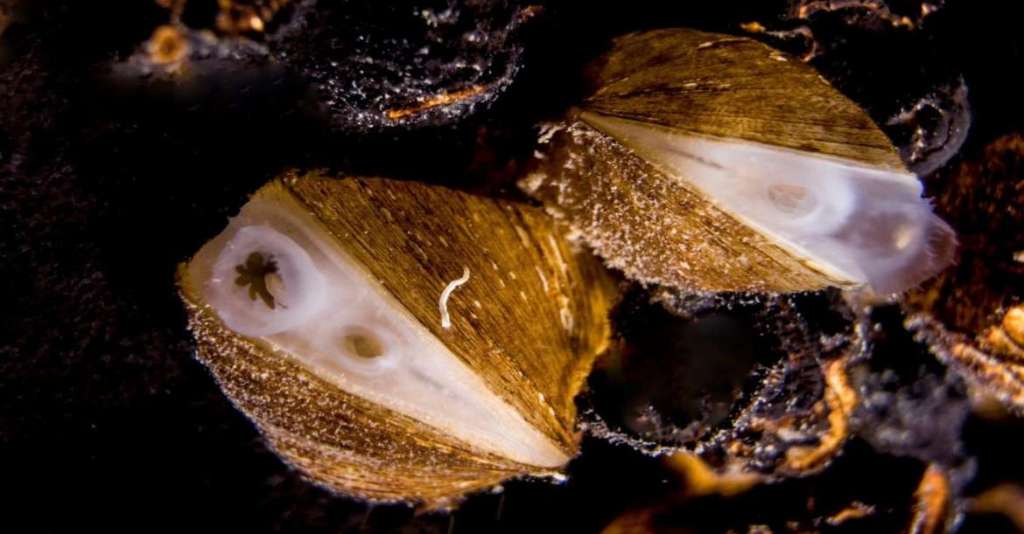
Golden mussels growing on an invasive apple snail, observed by iNaturalist user wildlife_adventures on March 16, 2026. Our invasive species are starting to literally stack up!

It’s important to note that there was really nothing that could be done to stop the mussels from getting into the Aqueduct, once they had infested the Delta. This is a water supply that millions of people rely on for drinking water, irrigation for crops and other uses. We can’t just turn off the pumps, because lives depend on this water consistently making its way south, and the mussels unfortunately used that to their advantage. The California Aqueduct is one of the engineering wonders of the world, but its amazing ability to transport water over mountains and to dozens of reservoirs has also made it an amazing way to transport mussels.
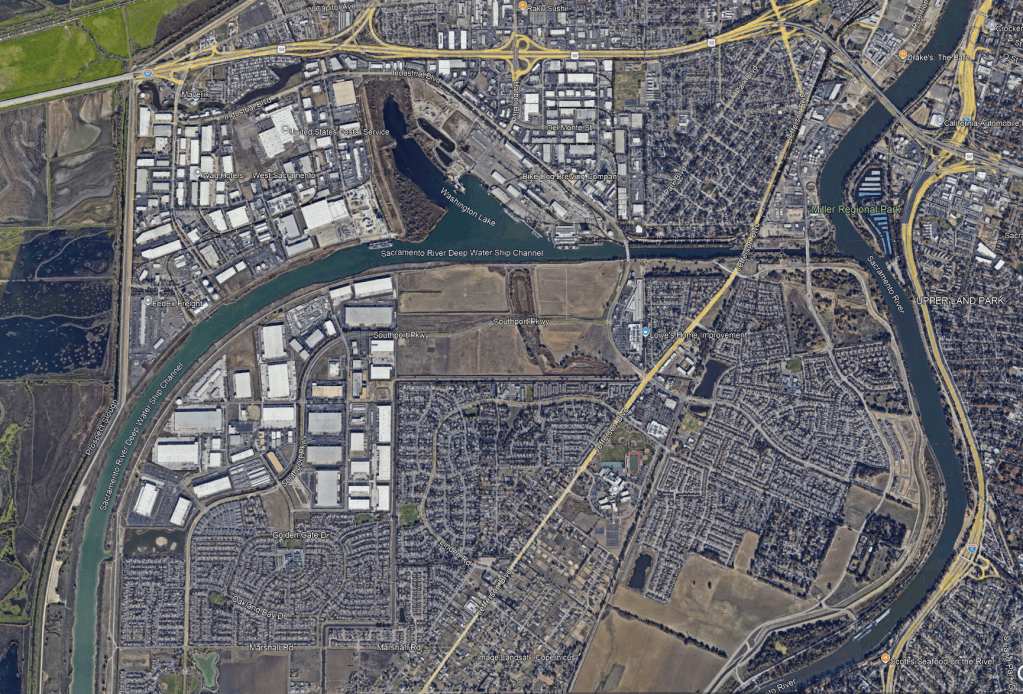
A view of Lake Washington, the northernmost place where golden mussels have been found. To the east, the Sacramento River is separated by two locks (gates that hold back water) which have been disused for decades. Imagery from Google Earth.

It has taken the mussels longer to move upstream against flow, where they need to attach to boats for a ride. But in 2026, they have begun to move up the Sacramento River to the North and the San Joaquin to the South. In June 2026 they were observed in Lake Washington in West Sacramento. Lake Washington is a popular place for boating, and it is quite likely they got there by attaching to boats, either brought to the Lake over land on trailers or via the Sacramento Deep Water Ship Channel. Lake Washington looks like it doesn’t directly connect to the Sacramento River to the east, since it ends with a couple disused locks (anyone, write to me and correct me if I’m wrong!). So it may represent a dead end for the mussels, unless someone takes a boat by land to enter the Sacramento River from there. Once mussels reach the main Sacramento River, it will be open season for them to head far north towards Yuba City attached to boats. Similarly, in the southern direction we are seeing them approach Fresno along the San Joaquin River, likely with the help of boats.
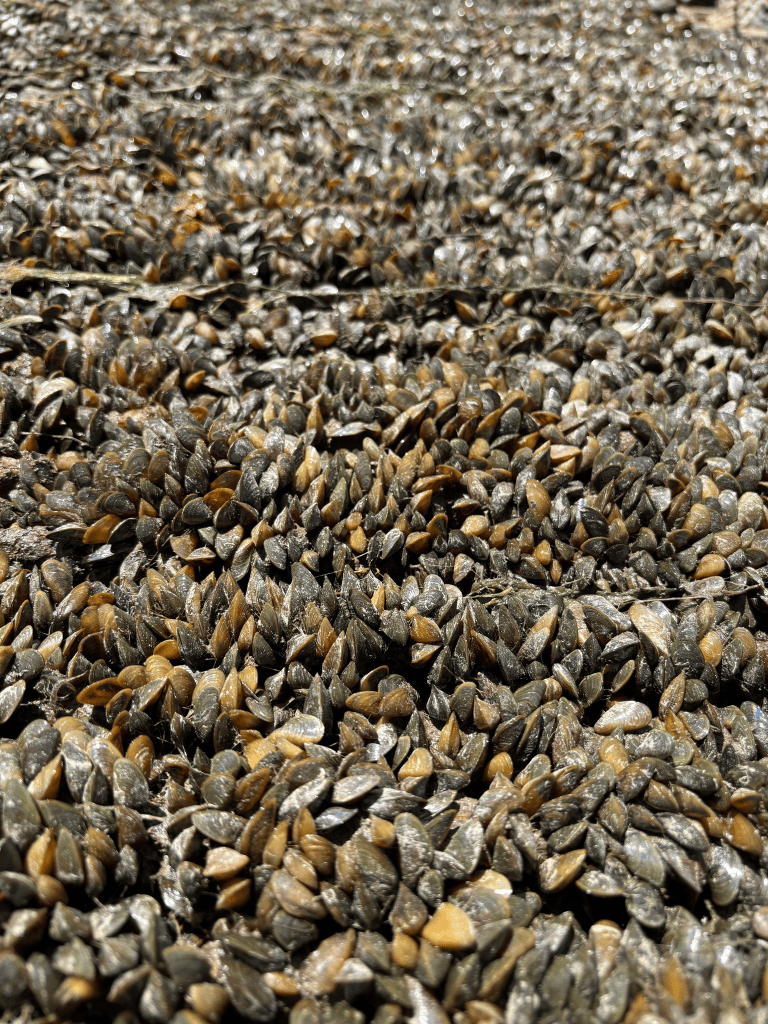
Mussels growing prolifically on a grate, observed by iNaturalist user gonzalli13 in May 2026 near Wasco, CA (north of Bakersfield in the Central Valley). The mussels seem to love growing on grates, inside of pipes, and other obscured places with lots of nooks and crannies.

So to review, in the two years since introduction, the mussels have spread to cover 400 miles of California, from San Diego to Sacramento (~200 miles/year). In South America, it took seven years to travel ~1200 miles from Montevideo, Uruguay to Corumba, Brazil (~170 miles/year). The California mussels are moving slightly faster per year here than they did in South America! It’s awesome that California Department of Fish and Wildlife has collected this data and made it accessible. It provides an unprecedented view into the invasion in real time, that clam people like me have been watching with horror over the last couple years. That has been one inspiring part of this whole situation to see: state workers (and various municipal, county and federal agencies that submitted data) are at the front line of protecting our water supplies and environment from the threat of these invasive pests! Similarly, citizen scientists on iNaturalist have also contributed observations of scientific interest, helping fill in the map over time. We all need to work together to track these mussels!

Note that in many of my descriptions above, I specified in many cases when mussels were “observed”, which is different than when they first arrived. The mussels are tiny and stealthy in their first weeks of life after attaching, basically impossible to see on the side of a boat or pier among the algae and dirt. They are often only observed when they get to be a centimeter long or so. When mussels were first observed at a couple sites near Stockton, CA, they had already infiltrated the aqueduct and were settling all along it!
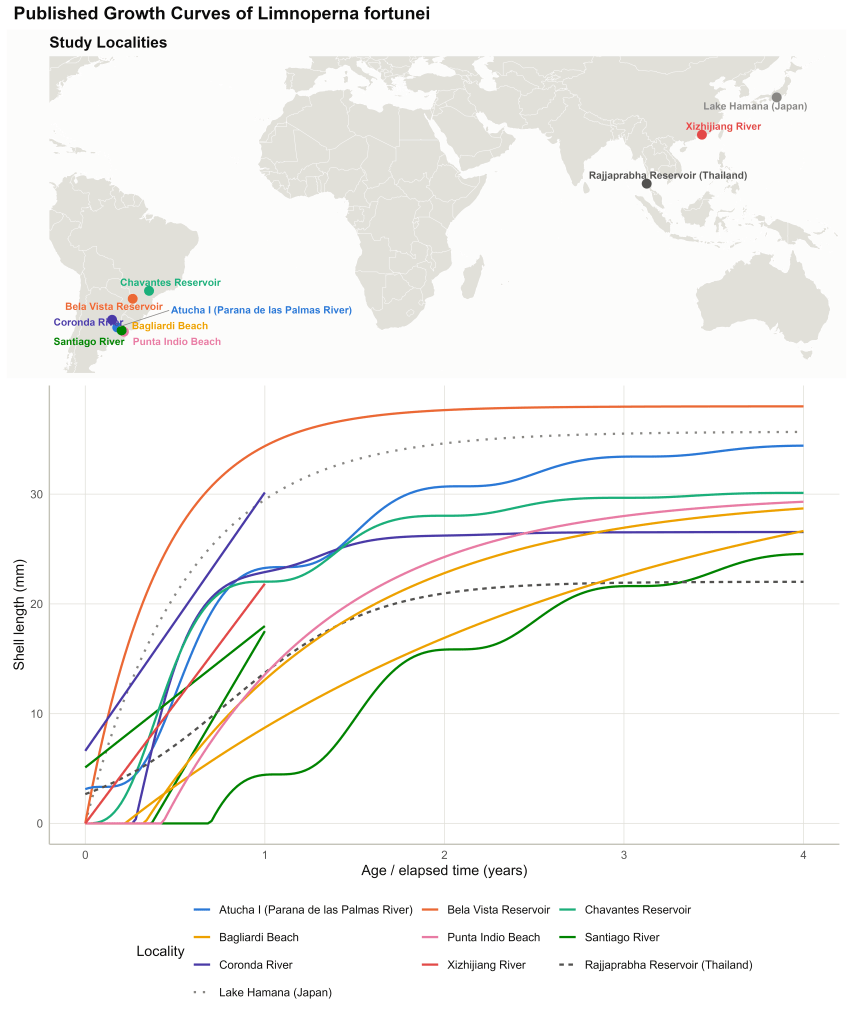
A collection of growth curves for golden mussels (with the locations around the world where the studies happened mapped). Some studies model their growth as a logistic curve, while others try to just use straight lines, or even account for seasonal increases and decreases in growth, which appear as wiggles.

We can try to track back when these mussels first attached to a surface (and therefore potentially when they were introduced) by using the size they were observed at and calculating their “birthday” based on their growth rate. But as is seen in many bivalves, these mussels can grow at very different rates depending on where they are. In the warm tropics of Brazil and a site in Japan, they have been observed to grow to their maximum size of over 3 cm in a year (very fast for bivalves!), but in cooler, saltier or polluted places they will take two or even three times longer to get to that size. In California, they were already being observed at over 3.5 cm long in late 2024, suggesting that 1.) They are very happy in CA and grow very quickly, and 2.) They may have been introduced here as early as 2023!
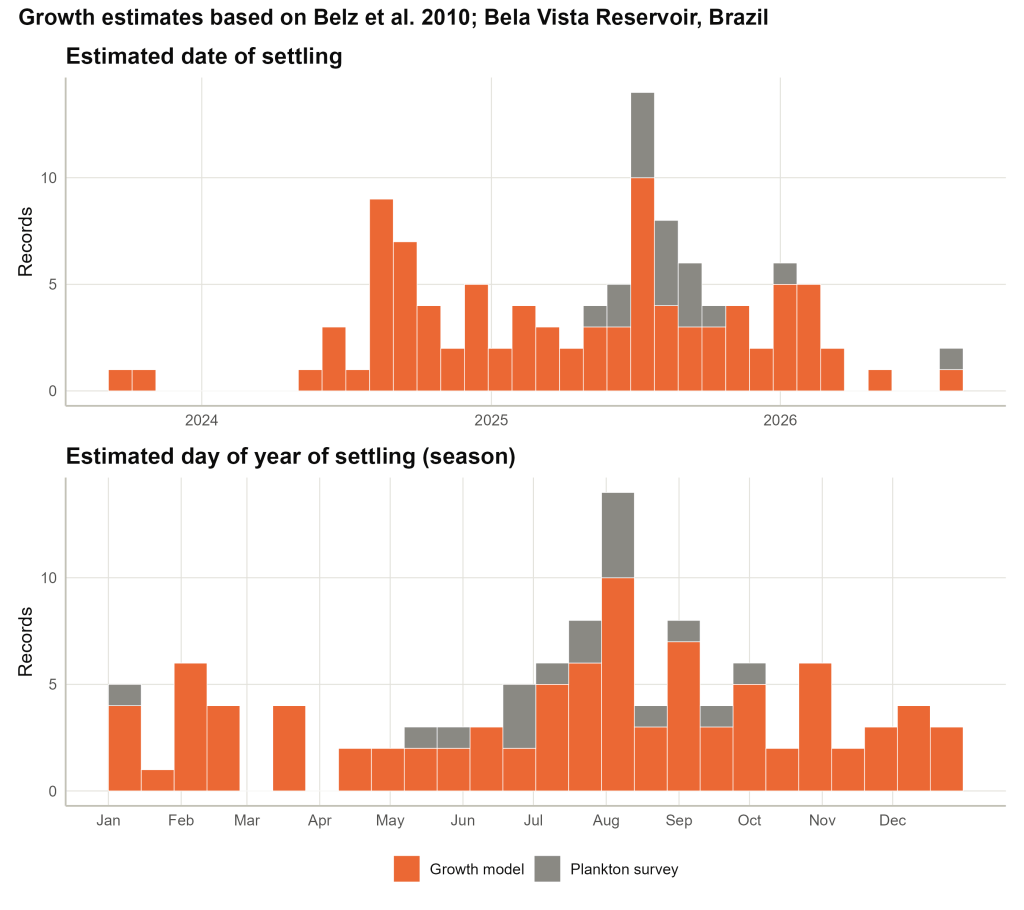
Bar plots with the top showing calculated date of settling of the mussels in California based on the fastest growth curve I could find (from Brazil). There are peaks in the late summer of 2024 and 2025. Gray bars stacked on top are observations of their plankton larvae. Data sourced from the CA Department of Fish and Wildlife mussel detections map.

If we use the fastest growth estimate I could find, from Bela Vista Reservoir in Brazil, and trace back all the reported sizes of mussels from the state database, we can estimate the times that they first settled and started to grow their shells. We see that according to this estimate, they arrived as early as late summer 2023. We also see bursts of settlement in late summer 2024 and 2025. This is corroborated by observations of planktonic mussel larvae, which seem to peak in the summer months. So late summer seems to be their preferred time to spawn, probably driven by temperature, but there also may be other bursts of reproduction at other times of year in different places!

I am hoping to help collect data to create a better growth curve for these mussels specific to California, so we can improve these estimates of when exactly they arrived and how quickly they can be expected to become an issue as they show up in more places in California and elsewhere. Knowing the rate and seasons they grow will be very important to water managers that are having to make investments in fighting these mussels via equipment upgrades, new water treatments, and other solutions. I am hoping through the power of science, we can try to protect our water from these invaders, and by understanding how they got here, I hope we can prevent new invasions of different bivalves from happening!
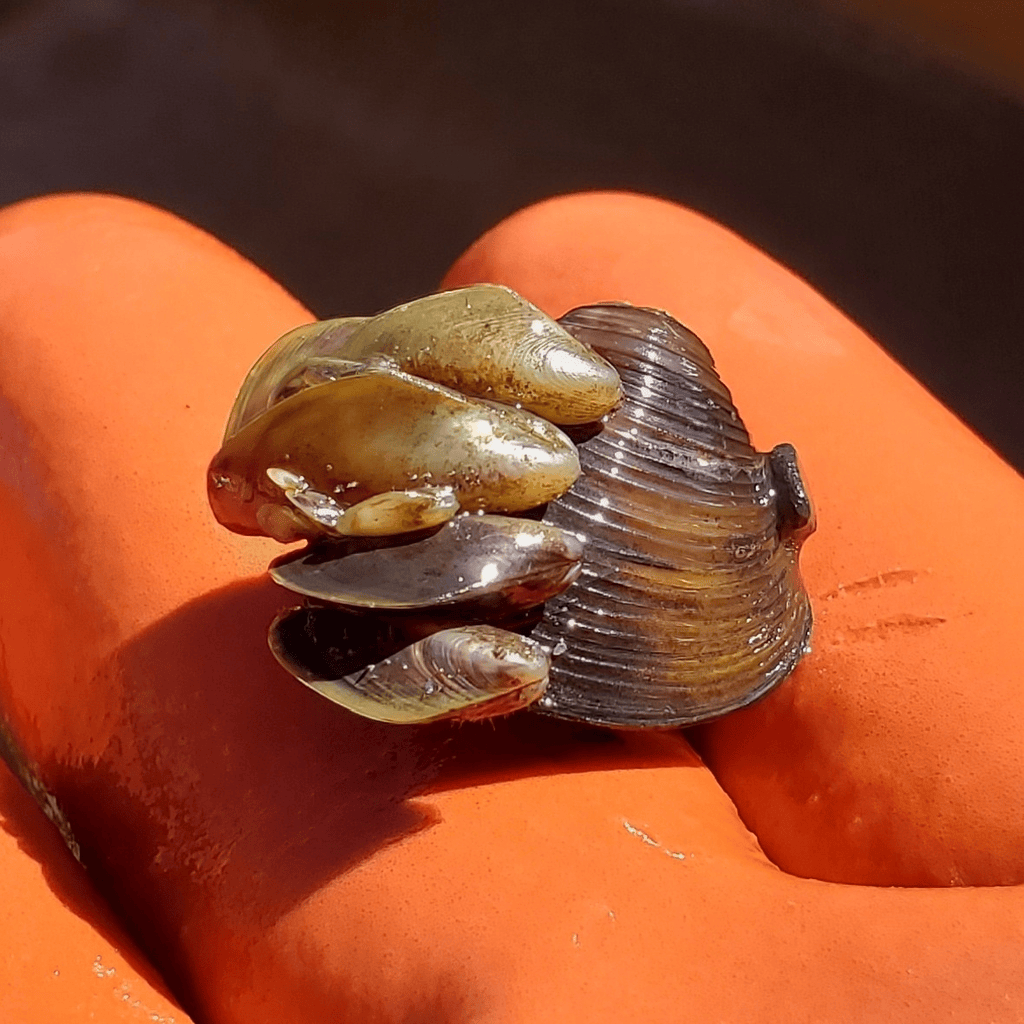
Golden mussels growing on the shell of Corbicula fluminea, the invasive Asian clam that appeared in the Delta in the 1940s. This behavior by the golden mussels parallels what has been seen for zebra mussels, which often attach to and potentially smother other bivalves. Photo taken by iNaturalist user pcarp, observed in the San Joaquin River near Stockton on October 21, 2025

Unfortunately in the case of these golden mussels, it seems certain at this point that they are here to stay in California. I find it likely that over the coming years, they will spread throughout California and to other neighboring western states. Personally, I am concerned about reports of them appearing in Suisun Marsh and even brackish areas of Grizzly Bay. Golden mussels can live in brackish water, but the exact upper end of salinity they can tolerate is not fully understood. Joining forces with the other invasive clams that have already re-engineered SF Bay since the 1980s, I worry we will again see a wave of ecological effects take hold in a place which has already suffered so many impacts from invasive species. I hate to end on a negative note, but I think this should be a warning shot for Californians that we are not doing enough to prevent invasive species from taking hold. We should not have had ships dumping their ballast water in the water supply that millions of people rely on, introducing mussels (and who knows what other species) into our midst. I hope policymakers will understand the urgency of this threat and work to make this the last major invasion of a bivalve for our state!

Gollum clams

Right: Gollum, Middle Earth. Photo credit: Peter Jackson, New Line Cinema. Left: Congeria kusceri. Photo credit: Helena Bilandžija

In some ways, living in a cave sounds pretty comfortable. A relatively stable year-round environment and refuge from above-ground predators/competitors make it a place that trogloditic (cave dwelling) animals can develop stable evolutionary forms which persist through long periods of time. Like the deep sea, caves are great places to look for “relict” organisms representative of groups that disappeared long ago on the surface. But living in a cave presents a lot of challenges that require specialized adaptations. The most obvious is the lack of light, the source of energy for photosynthesis supports food webs on the surface. Animals in caves must make a living eating material that flows in from the surface world, like bat gauno or debris from runoff. They can also make a living eating the microbes that directly feed off the rocks of the cave walls. Some caves also have methane or other geologically sourced gases that can serve as a food source, similar to the deep sea, where methane seeps and hydrothermal vents provide fuel for diverse and vibrant ecosystems.

A map of the 15 caves where Congeria has been found. Source: Bilandžija et al. 2013

You don’t need to watch Lord of the Rings to see that spending your life in a cave like Gollum requires serious changes to your lifestyle. But that’s exactly where we can find an unusual genus of freshwater mussels called Congeria. Congeria consists of three species found so far only in fifteen caves in the Dinaric Alps, a mountain range in Southeastern Europe stretching from Italy to Albania. These mountains are made from limestone that first formed at the bottom of a shallow tropical sea (picture the Bahamas and you get a good idea of how it would have looked) during the Mesozoic era, the time of the dinosaurs. This limestone (also called karst) was lifted up in the early Cenozoic (after the Cretaceous extinction) by tectonic activity due to the collision of the Adriatic microplate with Europe. This 645 km-long row of mountains is made of a highly soluble rock similar in chemical composition to Tums. Over millions of years, cracks in this karst have been widened by acidic rainwater dissolving away the limestone to make caves. The Dinaric Karst is chock-full of such caves which form a huge maze of interconnected systems deep into the earth (the limestone goes down for kilometers into the crust)!

Congeria kusceri shows its white, unpigmented flesh. Photo by Vedran Jalžić

So if you were to put all your cards into evolving to be a cave creature, the Dinaric Karst would be a great place to try it. All sorts of spooky trogloditic creatures are found down there, such as olm salamanders, cave-dwelling isopods (rolly-pollies), and more. But Congeria is of particular interest because it is a remnant of a group of mussels that was once much more prevalent across this area of Europe, once a huge mass of swamps and lakes called Paratethys. Many species of mussels in the same family as Congeria can be found as fossils in rocks covering an area reaching from Switzerland to Lake Aral in Central Asia. But over time, the climate and geography of the area changed and almost all of these species went extinct. It was once assumed that Congeria had itself gone extinct 5 million years ago, as it was only known from fossils.

Congeria kusceri. Photo by The Croatian Biospeleological Society

In the 1960s, a team exploring the caves of the Dinaric Karst were shocked to find examples of living Congeria in caves. In many ways, the story was very similar to the discovery of coelocanths in the deep sea, a fish assumed to have gone extinct millions of years ago which was found by accident. These species are remnant twigs of previously lush branches of the tree of life. Such species are sometimes called “relict” taxa, or sometimes “living fossils.” Many biologists prefer not to use that phrase, because while these creatures may closely resemble the forms of their distant ancestors, they often have changed in all sorts of ways not easily visible to the naked eye. Congeria was unknown to us, but spent millions of years evolving to improve its fitness in its cave environment. Such groups thought extinct only to reappear later in the fossil record are also sometimes called “Lazarus taxa.” Like Lazarus in the biblical story, Congeria was thought dead only to reappear much later.

It appears the species making up Congeria were trapped in Paratethys first by the rise and retreat of the Mediterranean Sea and then trapped in caves following the drying up of Paratethys. For the past several million years, they have lived only in the cave systems of the Dinaric Alps. But like Gollum, they were not preserved exactly as they previously lived in the Paratethys. While other freshwater mussels continue to frolic like merry hobbits through the streams of the Dinaric Alps above, Congeria has adapted in all sorts of interesting ways to its life as spelunking animals.

Like other bivalves, Congeria makes a living filter feeding. But in caves, they don’t have access to the photosynthetic plankton food that is the main dietary staple for typical bivalves. Congeria instead feeds on whatever detritus flows its way through the waters of the caves, and it can’t be picky. Bivalves use their gills to catch food when filtering, and Congeria has a particularly bulked up set of gills to supercharge its ability to grab these particles. But the palps, organs to select which particles to actually bring to the animal’s mouth, are tiny to the point of being almost absent. As with Gollum, who was known to gobble down the occasional goblin, Congeria can’t be selective. They have to try to eat whatever comes its way, unlike other bivalves such as my Biosphere 2 clams, which spit out many of the particles they catch as “pseudofeces.”

In evolution, if you don’t use a feature, you often lose it. Organisms can’t afford to be sentimental about organs; if it saves energy and doesn’t cost any survival ability to cut out a particular feature, it will be reduced or lost over the generations. Like other cave animals, Congeria has lost almost all pigmentation since such pigments have no purpose in the absence of light. It also has a highly reduced foot, which is used by other freshwater bivalves to move around and dig in the sediment. In the stable, low energy environment of caves, a muscular foot would be a waste of energy. It has lost its statocysts; balance stones similar in function to our inner ear used by most mollusks to sense which direction is up. Since it settles on any available surface and doesn’t move, it makes sense to strike that item from the energy budget.

Congeria living comfortably out of water, one with valves open! Source Glavaš et al. 2017

Most bivalves in the freshwater mussel Dreissenidae family are “r strategists“, meaning they are like guppies or mice, producing and broadcast spawning a huge number of offspring. They don’t put too much energy into each offspring, and hope a certain small percentage of them will survive each year to keep the cycle going. R strategists often don’t live very long. Such a life strategy would be tough to sustain in isolated cave systems, which are a harsh environment in many ways, particularly regarding food supply for baby Congeria. Congeria instead has evolved to be a “K strategist” like humans or elephants. It “broods” its young rather than broadcast spawning. This process, found in other bivalves from extreme environments such as polar regions, involves taking in sperm to fertilize eggs internally. The mother clam then nurtures the embryos to a certain size, first within the gills and then in special pouches in the mantle tissue. This organ is called a marsupium; these clams are like kangaroos! Brooding is much more energy-intensive than broadcast spawning, since the mother is sharing energy with her babies, but the investment ensures that each baby Congeria will reach a larger size before leaving its mother’s shell, giving each one a better chance of surviving long term. In the resource-deprived environment of a cave, a little boost to reach maturity matters! Because real estate is fairly limited in its caves, Congeria can survive in very dense aggregations with over 1,600 individuals per square meter. These mussels are surprisingly selfless and communally living for such a harsh environment.

An acetate peel of the hinge of Congeria kusceri, showing annual growth lines used to tell its age. Source: Puljas et al. 2014.

As with Gollum, Congeria has become very long-lived. Individuals have been confirmed to live almost 60 years based on growth lines in its shell, and there are suggestions that they can live much longer. In the relatively predatory-free environment of the caves, Congeria can bet on not being killed before it reaches its prime. Instead, its greatest enemy is the fickle environment of the caves, which are dependent on water flow from the surface. Their shell growth is interrupted during the summer, when the waters of its cave become much less alkaline than at other times of year, depriving them of the calcium they need to build the shell. At other times they might have to survive extended periods being emersed from the water, when levels drop during the dry season or droughts. Most bivalves can only persist for hours in such conditions, but Congeria can survive 2 months out of water! For Congeria, it makes sense to bet on being able to survive as long as it can in the spot it settled, trying to reproduce little by little over a long period of time. In this way, it is not quite like Gollum, as it has evolved to live a long time to improve its ability to reproduce and pass on its genes, rather than out of selfish worship of a ring.

Like Gollum though, Congeria is very unique and fragile. The caves in which it lives are a sensitive environment, vulnerable to overdevelopment and pollution. Manipulation of groundwater has reduced the flow of water through these caves and thus restricted Congeria‘s habitat, wiping it out from areas of some caves. Because its population is inherently restricted by the “small pond” it inhabits, it would not take a big environmental disruption to wipe Congeria off of the map. To that end, Congeria is red-listed as endangered and is protected in most of its native countries. Still, we can only hope that even now there are other populations of Congeria waiting to be discovered, hidden in unexplored caverns deep in the Dinaric Karst.