And now for something completely non clam-related…a speculative essay about LOTR as an environmental allegory, drawing on my posts to social media last week that clearly struck a nerve.
I’m the first to admit that Sauron’s rule of Mordor was highly problematic. But frankly, I think those concerns, focusing largely on his foreign policy, have been discussed ad nauseam, and not enough attention has been paid to his legacy as a steward of the environment. Plentiful examples exist of Sauron’s all-seeing eye for conservation. One need look no further than the Dead Marshes. These scenic lands were a well-maintained string bog which represented one of the environmental gems of Mordor, and were maintained as a protected reserve where orcish patrols did not enter. The marshes were an innovative nature-based solution to the environmental challenge of the thousands of corpses left over after the Battle of Dagorlad. The Dark Lord in his wisdom allowed the wetlands to expand to mediate the damage left over and return those nutrients to the ecosystem.
The marshes hosted diverse populations of anaerobic bacteria which helped preserve the famed bog bodies of the area, leading to them being an important archaeological site. The microbes produced a small amount of natural methane, and while this reduced the ability of the marsh to sequester carbon from Mordorian industry, the resulting little candles were a major attraction for visiting ecotourists.
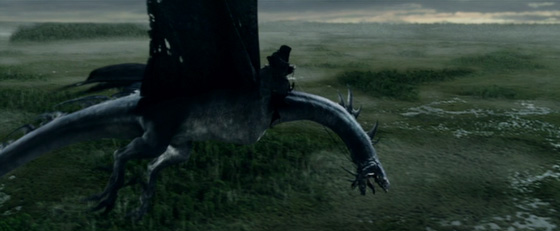
A nazgul conducting an aerial survey of the marshes
Some may argue that the marshes were not part of Mordor proper, which is true in the strict sense, but the marshes were clearly part of Sauron’s zone of influence, especially considering the extensive Ring Wraith aerial monitoring surveys he sent to survey the environmental health of the region and keep out interlopers of all sizes. Other critics pointed to a lack of crunchable birdses, but visitors approaching in early March are unlikely to observe many waterfowl, considering most would have migrated north by then to sites like Long Lake near the Lonely Mountain.
Sauron also contributed to forest reserves such as Mirkwood Old Growth Forest Biodiversity Reserve. While neurotoxins causing amnesia were present in some waterways, these were likely produced by harmful algal blooms resulting from Elvish untreated sewage. Mirkwood was home to a rich ecosystem supporting a vibrant population of endemic colonial spiders, Ungoliantus shelobii, which remain understudied. A small remnant spider population was also present in Cirith Ungol, supported by a locally administered feeding program. Unfortunately, that population was subject to poaching by an invading hobbit force during the War of the Ring.
Sauron’s detractors will point to environmental failures such as his alliance with Isengard, which reportedly resulted in some amount of deforestation. Saruman was previously an ally to Entish concerns, but necessities of the war effort resulted in previous protections being lifted, as is often the case in times of combat. While Sauron did attempt to encourage Saruman’s use of hydropower instead of biomass burning, Uruk-hai production was admittedly not as sustainable as it could have been. A full lifecycle carbon analysis was never conducted of their production processes, which were shrouded in secrecy, but they did represent a type of recycling.
Meanwhile, attempts to blame Sauron for the destruction of the Brown Lands have been undermined by a lack of primary sources, aside from Gondorian propaganda. The Entwives, the only known witnesses, did not respond to requests for comment for this report. Overall, it is clear that Sauron’s mixed legacy in foreign policy is improved somewhat when looking at his environmental record. One does not simply dismiss his environmental management ability.
Right: Gollum, Middle Earth. Photo credit: Peter Jackson, New Line Cinema. Left: Congeria kusceri. Photo credit: Helena Bilandžija
In some ways, living in a cave sounds pretty comfortable. A relatively stable year-round environment and refuge from above-ground predators/competitors make it a place that trogloditic (cave dwelling) animals can develop stable evolutionary forms which persist through long periods of time. Like the deep sea, caves are great places to look for “relict” organisms representative of groups that disappeared long ago on the surface. But living in a cave presents a lot of challenges that require specialized adaptations. The most obvious is the lack of light, the source of energy for photosynthesis supports food webs on the surface. Animals in caves must make a living eating material that flows in from the surface world, like bat gauno or debris from runoff. They can also make a living eating the microbes that directly feed off the rocks of the cave walls. Some caves also have methane or other geologically sourced gases that can serve as a food source, similar to the deep sea, where methane seeps and hydrothermal vents provide fuel for diverse and vibrant ecosystems.
You don’t need to watch Lord of the Rings to see that spending your life in a cave like Gollum requires serious changes to your lifestyle. But that’s exactly where we can find an unusual genus of freshwater mussels called Congeria. Congeria consists of three species found so far only in fifteen caves in the Dinaric Alps, a mountain range in Southeastern Europe stretching from Italy to Albania. These mountains are made from limestone that first formed at the bottom of a shallow tropical sea (picture the Bahamas and you get a good idea of how it would have looked) during the Mesozoic era, the time of the dinosaurs. This limestone (also called karst) was lifted up in the early Cenozoic (after the Cretaceous extinction) by tectonic activity due to the collision of the Adriatic microplate with Europe. This 645 km-long row of mountains is made of a highly soluble rock similar in chemical composition to Tums. Over millions of years, cracks in this karst have been widened by acidic rainwater dissolving away the limestone to make caves. The Dinaric Karst is chock-full of such caves which form a huge maze of interconnected systems deep into the earth (the limestone goes down for kilometers into the crust)!
Congeria kusceri shows its white, unpigmented flesh. Photo by Vedran Jalžić
So if you were to put all your cards into evolving to be a cave creature, the Dinaric Karst would be a great place to try it. All sorts of spooky trogloditic creatures are found down there, such as olm salamanders, cave-dwelling isopods (rolly-pollies), and more. But Congeria is of particular interest because it is a remnant of a group of mussels that was once much more prevalent across this area of Europe, once a huge mass of swamps and lakes called Paratethys. Many species of mussels in the same family as Congeria can be found as fossils in rocks covering an area reaching from Switzerland to Lake Aral in Central Asia. But over time, the climate and geography of the area changed and almost all of these species went extinct. It was once assumed that Congeria had itself gone extinct 5 million years ago, as it was only known from fossils.
Congeria kusceri. Photo by The Croatian Biospeleological Society
In the 1960s, a team exploring the caves of the Dinaric Karst were shocked to find examples of living Congeria in caves. In many ways, the story was very similar to the discovery of coelocanths in the deep sea, a fish assumed to have gone extinct millions of years ago which was found by accident. These species are remnant twigs of previously lush branches of the tree of life. Such species are sometimes called “relict” taxa, or sometimes “living fossils.” Many biologists prefer not to use that phrase, because while these creatures may closely resemble the forms of their distant ancestors, they often have changed in all sorts of ways not easily visible to the naked eye. Congeria was unknown to us, but spent millions of years evolving to improve its fitness in its cave environment. Such groups thought extinct only to reappear later in the fossil record are also sometimes called “Lazarus taxa.” Like Lazarus in the biblical story, Congeria was thought dead only to reappear much later.
It appears the species making up Congeria were trapped in Paratethys first by the rise and retreat of the Mediterranean Sea and then trapped in caves following the drying up of Paratethys. For the past several million years, they have lived only in the cave systems of the Dinaric Alps. But like Gollum, they were not preserved exactly as they previously lived in the Paratethys. While other freshwater mussels continue to frolic like merry hobbits through the streams of the Dinaric Alps above, Congeria has adapted in all sorts of interesting ways to its life as spelunking animals.
Like other bivalves, Congeria makes a living filter feeding. But in caves, they don’t have access to the photosynthetic plankton food that is the main dietary staple for typical bivalves. Congeria instead feeds on whatever detritus flows its way through the waters of the caves, and it can’t be picky. Bivalves use their gills to catch food when filtering, and Congeria has a particularly bulked up set of gills to supercharge its ability to grab these particles. But the palps, organs to select which particles to actually bring to the animal’s mouth, are tiny to the point of being almost absent. As with Gollum, who was known to gobble down the occasional goblin, Congeria can’t be selective. They have to try to eat whatever comes its way, unlike other bivalves such as my Biosphere 2 clams, which spit out many of the particles they catch as “pseudofeces.”
In evolution, if you don’t use a feature, you often lose it. Organisms can’t afford to be sentimental about organs; if it saves energy and doesn’t cost any survival ability to cut out a particular feature, it will be reduced or lost over the generations. Like other cave animals, Congeria has lost almost all pigmentation since such pigments have no purpose in the absence of light. It also has a highly reduced foot, which is used by other freshwater bivalves to move around and dig in the sediment. In the stable, low energy environment of caves, a muscular foot would be a waste of energy. It has lost its statocysts; balance stones similar in function to our inner ear used by most mollusks to sense which direction is up. Since it settles on any available surface and doesn’t move, it makes sense to strike that item from the energy budget.
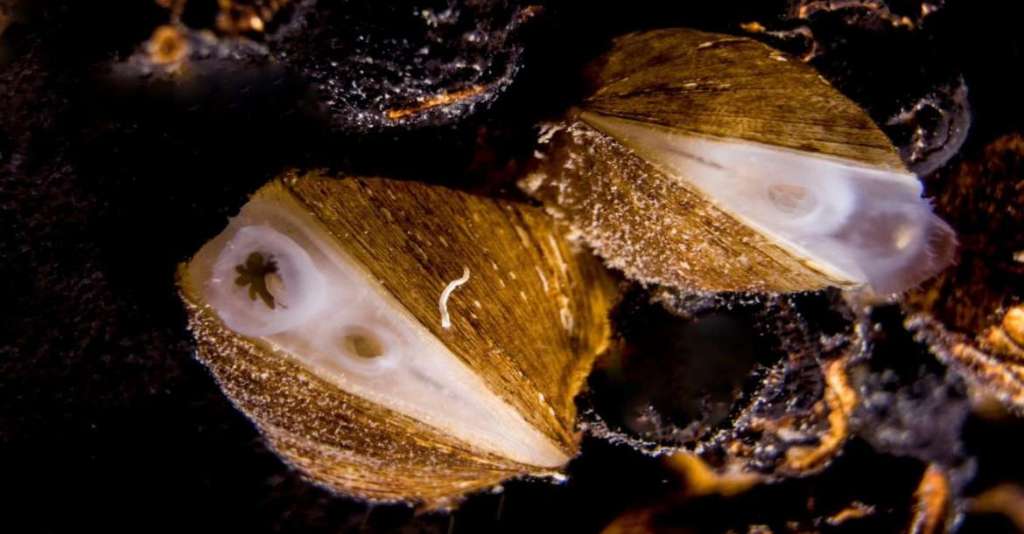
Congeria living comfortably out of water, one with valves open! Source Glavaš et al. 2017
Most bivalves in the freshwater mussel Dreissenidaefamily are “r strategists“, meaning they are like guppies or mice, producing and broadcast spawning a huge number of offspring. They don’t put too much energy into each offspring, and hope a certain small percentage of them will survive each year to keep the cycle going. R strategists often don’t live very long. Such a life strategy would be tough to sustain in isolated cave systems, which are a harsh environment in many ways, particularly regarding food supply for baby Congeria. Congeria instead has evolved to be a “K strategist” like humans or elephants. It “broods” its young rather than broadcast spawning. This process, found in other bivalves from extreme environments such as polar regions, involves taking in sperm to fertilize eggs internally. The mother clam then nurtures the embryos to a certain size, first within the gills and then in special pouches in the mantle tissue. This organ is called a marsupium; these clams are like kangaroos! Brooding is much more energy-intensive than broadcast spawning, since the mother is sharing energy with her babies, but the investment ensures that each baby Congeria will reach a larger size before leaving its mother’s shell, giving each one a better chance of surviving long term. In the resource-deprived environment of a cave, a little boost to reach maturity matters! Because real estate is fairly limited in its caves, Congeria can survive in very dense aggregations with over 1,600 individuals per square meter. These mussels are surprisingly selfless and communally living for such a harsh environment.
An acetate peel of the hinge of Congeria kusceri, showing annual growth lines used to tell its age. Source: Puljas et al. 2014.
As with Gollum, Congeria has become very long-lived. Individuals have been confirmed to live almost 60 years based on growth lines in its shell, and there are suggestions that they can live much longer. In the relatively predatory-free environment of the caves, Congeria can bet on not being killed before it reaches its prime. Instead, its greatest enemy is the fickle environment of the caves, which are dependent on water flow from the surface. Their shell growth is interrupted during the summer, when the waters of its cave become much less alkaline than at other times of year, depriving them of the calcium they need to build the shell. At other times they might have to survive extended periods being emersed from the water, when levels drop during the dry season or droughts. Most bivalves can only persist for hours in such conditions, but Congeria can survive 2 months out of water! For Congeria, it makes sense to bet on being able to survive as long as it can in the spot it settled, trying to reproduce little by little over a long period of time. In this way, it is not quite like Gollum, as it has evolved to live a long time to improve its ability to reproduce and pass on its genes, rather than out of selfish worship of a ring.
Like Gollum though, Congeria is very unique and fragile. The caves in which it lives are a sensitive environment, vulnerable to overdevelopment and pollution. Manipulation of groundwater has reduced the flow of water through these caves and thus restricted Congeria‘s habitat, wiping it out from areas of some caves. Because its population is inherently restricted by the “small pond” it inhabits, it would not take a big environmental disruption to wipe Congeria off of the map. To that end, Congeria is red-listed as endangered and is protected in most of its native countries. Still, we can only hope that even now there are other populations of Congeria waiting to be discovered, hidden in unexplored caverns deep in the Dinaric Karst.






 Clamsplaining