What cyborg clams can teach us about the ocean

Every clam is a door into the sea. If the “door” of its shell is open, the clam may be happily breathing, or eating, or doing other weirder things. If the door is closed, it may be hiding from a predator, or preventing itself from drying out at low tide, or protecting itself from some other source of stress. It turns out that by monitoring the opening and closing of a clam’s shell valves, a field called valvometry, scientists can learn a lot about the clam’s physiology, its ecology and the environment around it.

Valvometry involves attaching waterproof sensors to each shell valve of the bivalve, to measure the distance between them and their movement. Researchers have used valvometers to figure out that bivalves can be disturbed by underwater pollution like oil spills, harmful algal blooms, and more unexpected sources such as noise and light pollution.

A great video from Tom Scott discussing a Polish program to monitor water quality with valvometry

Giant clams are a group of unusually large bivalves (some species reach up to 3 feet long!) native to coral reefs of the Indo-Pacific, from Australia to Israel. They grow to such large size with the help of symbiotic algae living in their flesh, the same kind that corals partner with the corals that build the reefs. The algae photosynthesize and share the sugars they make with their host clam, and the clam gives the algae nitrogen fertilizer and other nutrients, a safe home from predation and even helps channel light to the algae using reflective cells called iridophores.
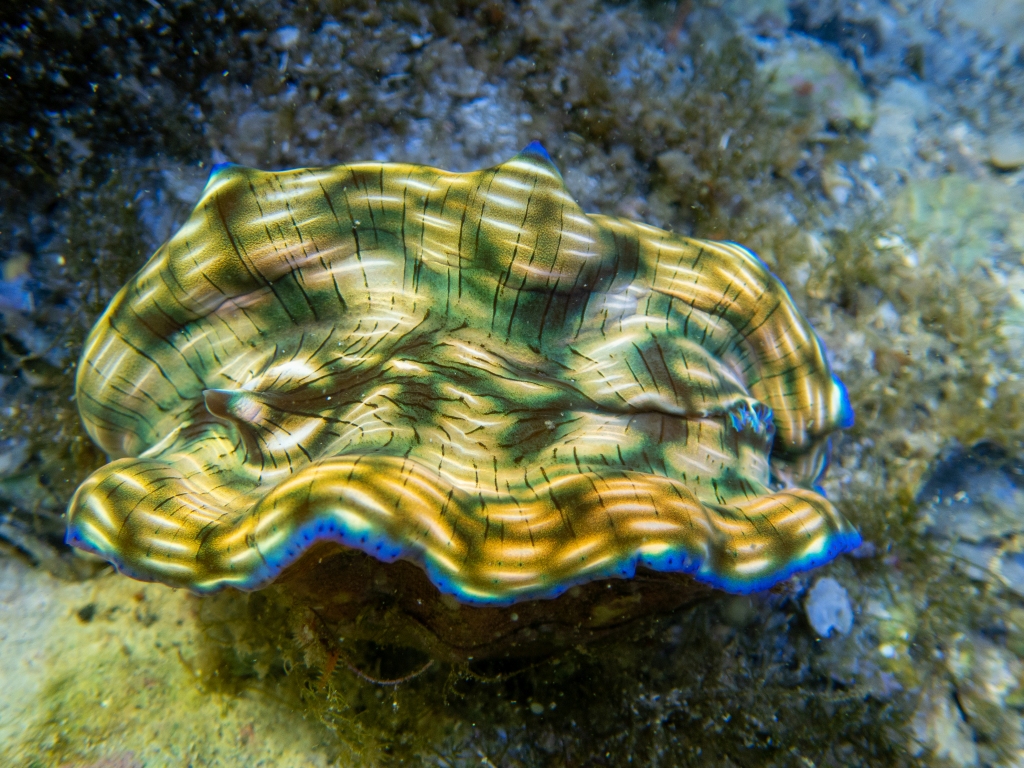
A Tridacna derasa clam in the Biosphere ocean. It has deep green flesh, covered with yellow stripes of iridophores and a blue fringe at the edge.

Previous studies have used valvometers on giant clams, but I was always perplexed by how few studies there were: only two that I know of! One study on clams in New Caledonia figured out that the clams partially close every night and bask wide open during the day. The clams’ shell opening behavior and growth was found to become more erratic at temperatures above 27 °C, and when light levels become too great. Another study showed the clams start to clam up when exposed to UV light to protect themselves from a sort of sunburn, which is a real threat in the shallow reef waters they live in.
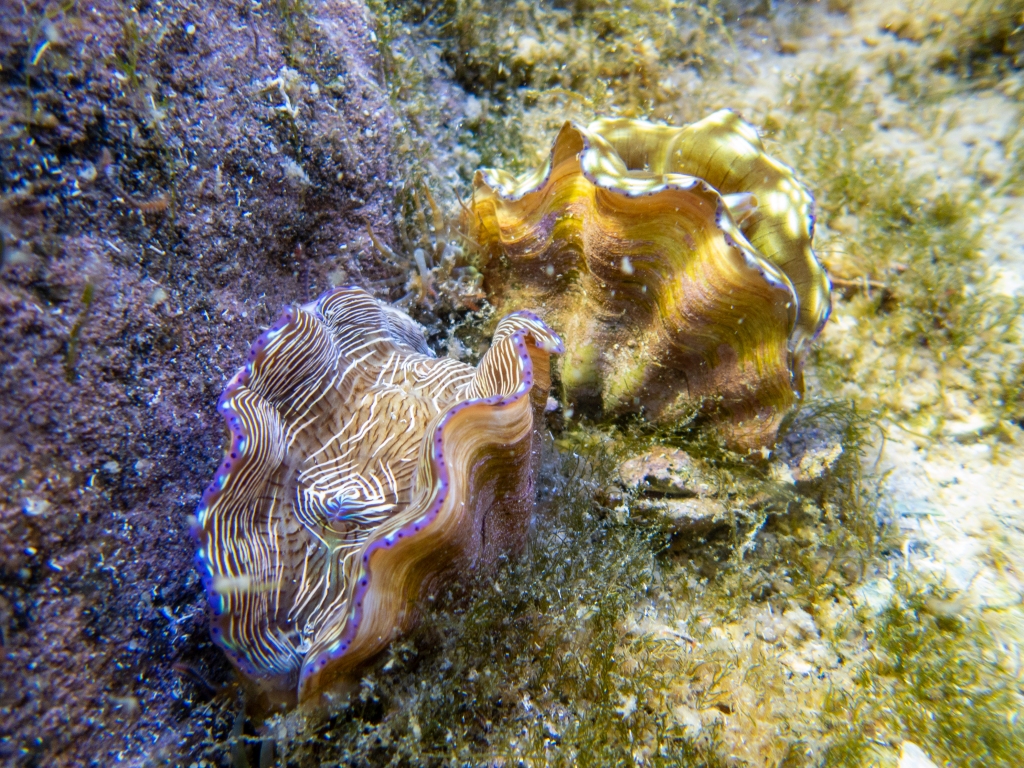
Two clams sitting next to each other in the B2 ocean. They often moved themselves to “snuggle” next to each other this way. Safety in numbers!

There is clearly a lot of information to pick up about how clams react to their environments, which can help us understand the health of the clams and also the corals around them. Coral reefs are under global stress from climate change, overfishing and pollution. Giant clams are some of the most prolific and widespread bivalve inhabitants of reefs, and represent an appealing potential biomonitor of reef conditions. Many giant clam species are threatened by the same stressors that influence the corals which build the reefs they live on, as well as overharvesting for food and their shells. For that reason, wild examples should clearly not be bothered by applying valvometric sensors. But giant clams are increasingly grown for the aquarium trade, resulting in a wealth of cultured specimens which could serve as sentinels of reef health, if they were fitted out with sensors. All of these motivators made me more and more curious of why we don’t have more literature monitoring the behavior of these clams with valve sensors.

I wondered if one of the limiting factors preventing the use of valvometry on giant clams is expense and ease of access. Giant clams live primarily in regions bordering developing countries in the Indo-Pacific, and almost all the professional aquaculture of clams for the reef trade happens in such countries, including places like Palau, Thailand, and New Caledonia. These countries are far removed from the places where most of the proprietary valvometric systems are manufactured. These systems can cost several thousand dollars even in Europe, never mind Palau, where arranging the import of electronics can be difficult.

When I started my postdoctoral fellowship at Biosphere 2 in 2020, I set out to grow two dozen smooth giant clams (Tridacna derasa, a species which can grow to about 2 feet long) in the controlled environment of the Biosphere 2 ocean, a 700,000 gallon (over 2.6 million liter) saltwater tank used to grow corals and tropical fish and kept at a stable year-round temperature of 25 °C. We suspended a series of LED lights intended to simulate the powerful light levels these clams experience in the wild (light is a lot brighter in the tropics than it is in Arizona!). The main focus of my project involved measuring the shell chemistry of the clams, to determine how their body chemistry changed as they grew from mostly getting their energy from filtering algae food from the water like other clams, to getting most of their energy from sunlight like a plant. But as a “side project” I set about measuring the behavior of the clams with custom-built valvometers based on open-source, inexpensive hardware that would be more accessible to researchers in the developing world. That work has since been published in PLoS One!

In our design, we used Hall effect sensors. Hall effect sensors generate a voltage when a change in magnetic field is detected. They are cheap, easily obtained for less than $1.50 apiece and are common in the electronics hobby trade. You might have encountered one in a home security system door/window sensor, where they help detect if a door is open or shut. We stuck a hall sensor soldered to a long copper cable to one valve of a clam, and a small magnet to the other valve. When the clam closed, we could measure exactly how closed it was. You can see why I started off by calling clams doors into the sea: we were literally measuring them that way!
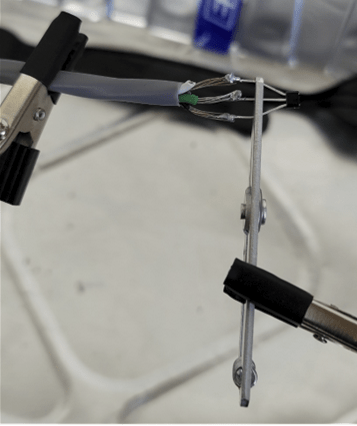
Showing the sensor soldered to the three strands of the cable.

But here the first challenge of my project appeared. The off-the-shelf Hall sensors don’t come in waterproof form, and I learned quickly that the ocean really, really loves to break my gear. After dozens of failures, I settled on coating the sensors in waterproof grease, wrapping that in heat-shrink tubing and then sealing that inside of aquarium-grade silicone. During this process, a gifted technician at Biosphere 2 named Douglas Cline helped with iterating on the first prototypes. At a certain point I taught myself to solder so I could do my part to improve the sensors.

It was also hard to figure out how to attach the sensors and magnets to the clams in a durable way. Neither of the prior studies mentioned how they attached the sensors to giant clams, and I tried and failed with literally a dozen different ways before settling on “pool putty,” a two-part adhesive often used to seal leaks in pools that can cure underwater. I found the pool putty had trouble attaching to the clams’ shells on its own, so I combined it with a special kind of cyanoacrylate superglue called “frag glue,” often used to attach pieces of corals to growth stubs. I also had to find a way to attach it to the clams without stressing them out. I determined five minutes out of the water was enough time to get the sensors attached to the clams, after which they could be returned to the water to finish curing. While giant clams are adapted to spend extended periods out of the water in their natural intertidal environment, we wanted to make sure to minimize their stress however possible, to ensure they would show natural cycles of behavior in the data.
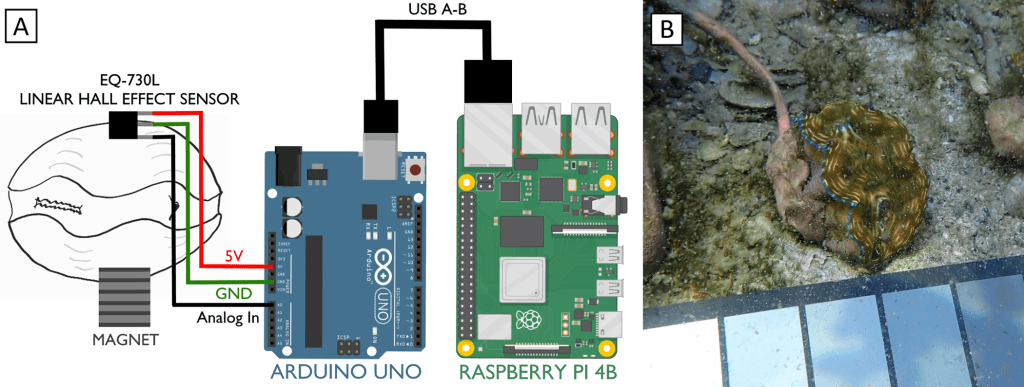
Figure from the paper showing: A) schematic of the sensor attached to the clam, linked to an Arduino microcontroller and Raspberry pi computer. B) A sensor attached to one of the clams

We were pleased to see the cyborg clams seemed to pay no mind to the sensors. Giant clams are adapted to encourage all sorts of other critters to live on their shells as a form of natural camouflage, and I think the clams interpreted the sensors as pieces of coral or anemones sticking to the side of their shell. Whatever the case, as long as we kept the cable pointing to the side away from the clams’ flesh, they opened five minutes after being returned to the water, and their behavior and growth rates were indistinguishable from the clams that didn’t have sensors attached.

One of what became many sunsets on the Biosphere 2 ocean shore troubleshooting the clam sensors! Pardon the chaos: mad scientist at work!

So how did we measure the voltages coming from the sensors? Our design featured an Arduino microcontroller, sort of like a smart circuit board which can measure the voltages coming back over the copper cables. Arduinos are very cheap, and we chose a $25 model. Even more importantly, Arduino has a huge library of plug-ins available to keep the exact time of each observation using a clock attachment, and the data can be uploaded to SD cards or an attached computer. For the attached computer, I used a Raspberry Pi computer, which are open-source Linux-based tiny computers that are very cheap! Or rather they were very cheap before the pandemic, but fortunately there a lot of open-source alternatives that can be obtained more cheaply. We logged the data on the Raspberry Pi as it rolled over from the Arduino, and I could watch the read-out on a monitor right on the Biosphere 2 beach. We set the Arduino to record every 5 seconds.

Sensors attached to four of the clams. Notice the one on top left has closed a bit, after sensing my presence! They have eyes so they were able to detect me 😀

We ran the sensors for three months. During that time, the baby giant clams grew almost an inch! What did the sensors record them doing? During the day, the clams basked wide-open, exposing as much of their tissue as possible to light (other than the times that I disturbed them by swimming above them, of course)! This schedule of opening aligned pretty closely with the times that maximum sunlight hit their part of the Biosphere 2 ocean: the mornings, because the clams were on the east side of the building. At this time of day, the clams want to expose their symbiotic algae to as much light as possible, so they can conduct photosynthesis and make sugars that the clams use as food!
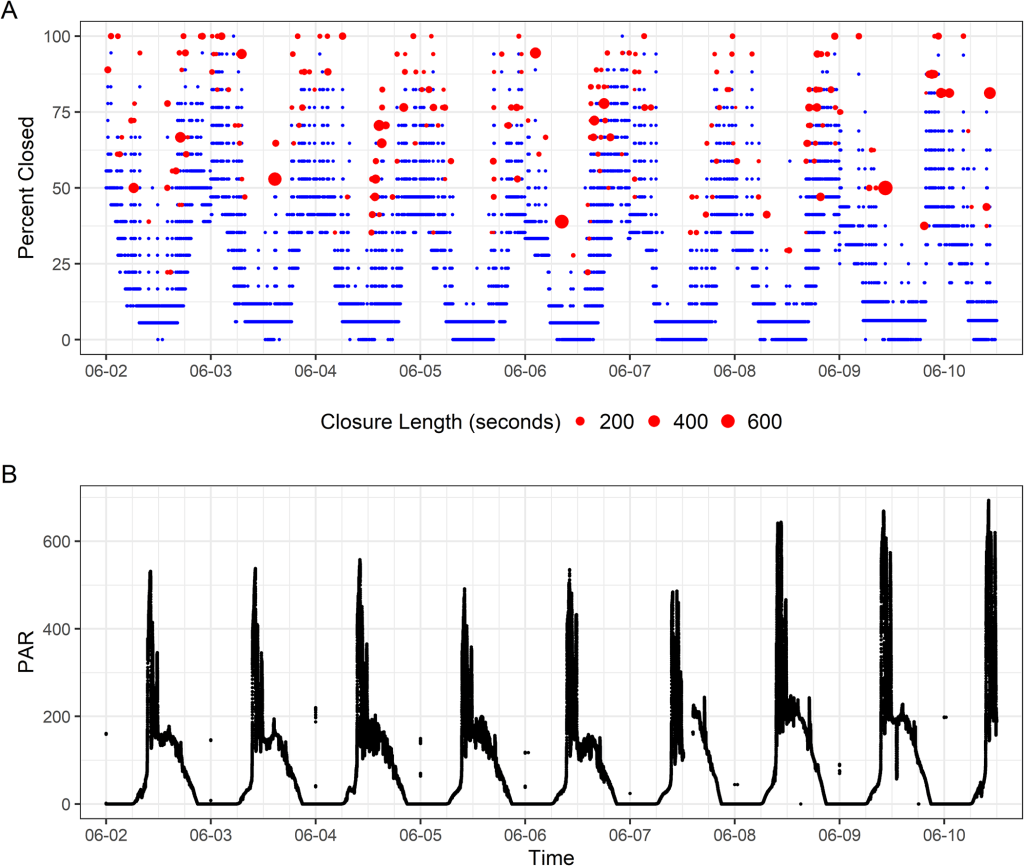
A) Plot of the valvometry data. Points higher on the plot mean the clam was more closed, up to 100% closed. The clams proceeded by opening in the early morning and then closing in the early afternoon. The big red circles represent times that the clams closed briefly, with bigger circles representing a longer time spent closed. Most of these rapid closures happened at night. B. A plot of Photosynthetically active Radiation (the amount of light the clams had to use for photosynthesis). The highest values were in the mid-morning when the clam lights were running in combination with direct sunlight hitting them from above.

Around mid-afternoon, the clams started to close partially, to about half closed. Why might that be? My hypothesis is that this posture represents a kind of “defensive crouch” to protect themselves from predators, in this case fireworms that live in the Biosphere 2 Ocean and were constantly kicking the clams’ tires. Similar nighttime behavior was observed in wild clams in a previous study, but not in a study that took place in a small predator-free terrarium tank. By remaining partially closed, the clams are prepared to rapidly close completely if they feel a predator approaching. But they only expend that energy of staying in that posture if predators are around!
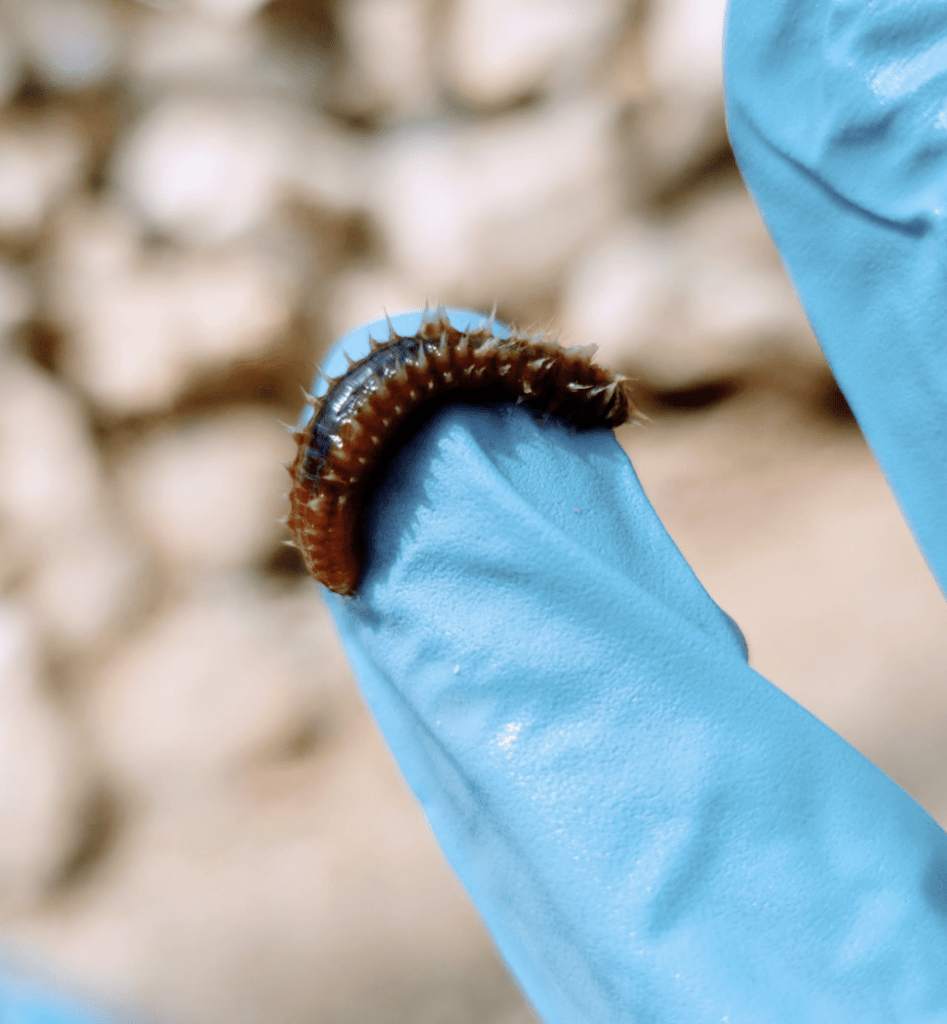
One of the fireworms that proved to be my nemesis and continually attacked the clams during the experiment

And approach the fireworms did. We observed frequent closures at night lasting anywhere from a few seconds to hours, likely partially related to the activity of the worms around the clams. But the clams were engaging in another activity at night: filter feeding! Giant clams really get to have their cake and eat it too, because during the day, they act like a plant, but at night, they eat other plants in the form of plankton that they filter feed out of the water using their gills! At regular intervals, the clams need to clear uneaten material from their gills in a process sometimes called “valve-clapping”. The clams yank their shell valves together rapidly to force water out, blowing out pseudofeces: unwanted material packaged with mucus. We measured this valve-clapping mostly at night. The clams are likely scheduling this activity for the night-time so they can prioritize staying open and filter feeding during the day!

Figure comparing how often clams closed per day to measures of how high plankton numbers were in the Biosphere 2 ocean (chlorophyll is a marker of phytoplankton while phycocyanin is a measure of cyanobacteria), and how high the light levels were. Peaks in closure activity often happened shortly after rises in algae.

We observed that the frequency of valve clapping aligned closely with the rises and falls of chlorophyll concentration in the Biosphere 2 ocean, which is a measure of how much plankton is in the water column. The clams would engage in a burst of valve clapping around 4 days on average after a bloom in chlorophyll, suggesting they were filtering out plankton after they had died and settled to the bottom where the clams could eat them. We also found that the clam’s filtering activity peaked at times of highest pH. This likely is due to the fact that higher pH means the algae around the clams are being more active, and pulling CO2 in from the water to use in photosynthesis, making the water less acidic. More photosynthesis means potentially more material for the clams to filter through! This data helps quantify how giant clams help filter the water in their native environments! Coral reefs depend on very clear transparent water to allow maximum sunlight to reach the corals, and the filtering activity of giant clams likely plays a big role in helping preserve those conditions!

So we found that by adding sensors to clams, we could record their ability to feed from the sun, their feeding on plankton around them and their avoidance of predators. How can this technique be used next? We hope that by using cheap off-the-shelf resources and open-source software, we can enable more sensors to be put on clams all over the world, such as places where giant clams are farmed in Palau, New Caledonia, Thailand, Taiwan, Malaysia and more! If we can collect data on clam activity from all these places, we can compare how their feeding patterns differ in places that have more or less plankton floating by, or have more or less sunlight available, or different predators that affect the clams’ behavior. This data would have importance to the clams’ conservation, as well as our understanding of the reef overall. In future years, I hope we can develop a global network of cyborg giant clams from the Red Sea to the Great Barrier Reef, so we can better understand how these oversized and conspicuous but still mysterious bivalve work their magic!

New job! Where I’m going and how I got here

Richmond, California’s Finances Remain Shaky
Richmond, CA from the air, showing the turbid waters of the SF Bay

Well folks, it finally happened. I found a permanent scientific job. On January 31st, I’ll be starting as an Environmental Scientist at the San Francisco Estuary Institute (SFEI), working on the Nutrient Management Strategy (NMS) program. NMS is a group trying to understand how nutrient supply in the San Francisco Bay works.

The SF Bay is an extremely nutrient-enriched environment (eutrophic) due to human pollution and natural factors, to the extent that if all other factors were equal, scientists would expect it to be a nasty green sludgy mess. Yet up to today, due to factors that are still debated, the SF Bay is in much better shape than it should be. It is not a dead zone, choked off by algal blooms and oxygen-starved in the way that other high-productivity regions such as parts of the Gulf of Mexico have become. Those factors may include the cloudiness (turbidity) of the Bay’s water limiting algae growth, naturally rapid tidal mixing with ocean water, and the influence of clams and other grazing animals keeping the populations of potentially harmful plankton suppressed.

However, there is also evidence that this resilience may be fading as water temperatures in the Bay increase and the ecology of the system changes with climate change. Oxygen levels are dropping and levels of harmful algae are rising, which endangers the health and livelihoods of millions of people in the SF Bay area who depend on a clean, ecologically functioning SF Bay. In my role at NMS, I will be assisting in processing and interpreting huge quantities of environmental data on temperature, dissolved oxygen, water flow, light levels, algae concentrations, and harmful algae toxins, to help figure out how the SF Bay works and how we can protect it. I will be assisting another scientist joining the team in deploying more sensors to monitor the Bay on a minute by minute basis, and also packaging the data to help create models which allow us to figure out the various moving parts that make it work.

In a way, this is oddly similar to the work I’ve done during my postdoc at Biosphere 2, where I’ve been growing giant clams in their 700,000 gallon ocean tank since May 2020. The clams are biological sensors have been recording the environment of the Biosphere 2 ocean through their shells and valve opening/closing activity, and I have had to decode their diaries through comparison with the environmental data we collect on light, pH, dissolved oxygen, chlorophyll and other measurements. The SF Bay is a site of enormously influential research which has been important to understand estuaries around the world, but it is still a mysterious body of water in many ways. NMS is trying to understand how all its complex pieces fit together, much like I’ve been doing at Biosphere 2, which is why I jumped at the opportunity to apply for the job.

I also am excited to get involved in this work because it’s immensely important for everyday people’s lives. The SF Bay provides millions of people with food, employment, recreation and overall well-being, and the science that NMS produces has real-world value for making policy and a concrete plan to keep the Bay healthy. It represents exactly the kind of science that I wanted to do since I first jumped into environmental biology as a 19-year-old at USC. At that time, I was interning at JPL studying historical trends in California rainfall data, so this new job represents a homecoming of sorts to California water science!

This job will be a bit of a change of pace from my present work as at first, because I’ll be part of a scientific team with a shared mission, unlike most of my prior research, where I came up with ideas, pitched them to my advisors and funders and then coordinated the projects to collect and analyze data. There will be more teamwork, and while academic publications will still be one of our products, we also will be writing reports for policymakers and stakeholders who are deciding on how to regulate nutrient levels in the Bay.

I also won’t be working with clams on an everyday basis! But as I mentioned before, clams do play a major role in the Bay in terms of filtering the water, and so it is likely we will need to understand the activities of the clams and other grazers to explain the trends in nutrients that we see. I didn’t start as a Clam Man, but my curiosity about clams meant that my attention kept being drawn to these enigmatic but influential creatures, and I expect that dynamic will continue. I am, and always will be, Dan the Clam Man.

I will continue to get my present clam projects out the door as publications, so there will be lots of clamsplaining in the future months as those get out the door. Regarding the Biosphere 2 clams, we still have four individuals of Tridacna derasa (the smooth giant clam) growing in the 700,000 gallon ocean tank, and intend to leave them as long-term research subjects and an exhibit for visitors to enjoy and learn about. We also have proposals in the work for new projects to expand on this work. I hope I can continue to visit in the coming decades and see our clams grow to be true giants, two feet in length! I also hope to acquire pet giant clams of my own, with names rather than specimen numbers, to be my friends rather than my research subjects.

I’ll be starting the new job remotely at the end of this month, to give myself time to tie off loose ends in Tucson, intending to move to the Bay Area by March. I will really miss Biosphere 2 and Tucson, but this isn’t the last they’ll see of me, because my collaborations with people here will continue into the future. I knew from the start as a postdoctoral researcher that my position would not be permanent, but it is still bittersweet to leave. I will miss hiking in the Sonoran desert, swimming in the Biosphere 2 ocean tank and also my advisor Diane Thompson and her lab here, full of people who have been a joy to work with.

But I am excited for this new chapter, because the postdoc life has been lately losing its luster for me. I’ve enjoyed being a postdoc for the freedom it entails, both in my research topics and the way I structure that work. But postdoc work is emotionally exhausting, as I have been a journeying academic contractor on “soft money”. My employment for the following year has always been contingent on the next grant coming through. Moving between different institutions on different continents has been a big weight on my family and my partner, who I miss greatly.

As a postdoc, while I’ve had fun and wouldn’t change anything about it, I have felt like a plane trying to take off in unfavorable weather. I could see the end of the runway approaching as my current funding ends in May, which was a scary feeling. I’m willing to hustle and fight for research funding, but not my basic income. Looking back, I have applied to around 45-50 academic positions (including postdocs) since finishing my PhD and got interviewed for less than ten percent of those, and received offers for two postdocs. When I got the offer from SFEI, which was itself a rigorous, multi-stage process over months, I cannot describe what a relief it was to clear out my “job applications” folder in my to-do list. This SFEI job will allow me to pursue marine science that helps the environment and people, in a more emotionally sustainable way.

I’m excited to start my next chapter and share with you all the discoveries our team makes about the SF Bay, while also continuing to clamsplain here on my own time. Keep an eye out for my Biosphere 2 studies, which will be rolling out over the next months as the data arrives!

Recent Science Communication!

At Biosphere 2, our science is essentially done in public. Every time I’m in the water checking on our clams and the sensors around them, I’m in view of the public and essentially an attraction for the public to watch. This is a really unique way to do science unlike any of my past experience, when I’ve been out in the field with a collaborator, or in the lab with a laboratory technician. I was initially intimidated by the idea of doing my science with an audience, but I’ve decided to lean into it as a huge opportunity. It is rare that the public gets to see all the steps going into our science; they usually only see the end of the story and not the whole journey leading up to that point. So recently I participated in two new ways of sharing my work while it’s in progress with the public.

The first was a collaboration with Mari Clevin, a videographer with the University of Arizona who made a really nice profile of my crazy clam journey. It was a lot of fun showing her around B2, trying to capture what it’s like to work here. It was fascinating seeing how all her footage and interviews came together into a video, and how she captured the key points of our conversation into a narrative!

The other scicomm event I participated in was a “Research Show and Tell” event run by the PAGES Early Career Network. Early Career Researchers include PhD students, postdoctoral researchers like me, and early career faculty. The ECN is intended to help us band together to share opportunities and plan events relevant to our interests. Among the North American regional representatives for the ECN, we saw a real need for more informal ways to share our research to an advanced audience of our peers. We’re all burned out from Zoom webinars, and on the other side Zoom coffee hours don’t typically provide much opportunity to share scientific content, so there’s a real need for events in the middle. So I was excited to share my research with a group of my peers, touring them around the Biosphere, showing them my clams via pre-recorded video and then having a Q and A to describe the work. It was a lot of fun and you can watch the whole hour-long event below!

Biosphere 2 Update!

A view from my parking spot at work

I am now several months into my postdoctoral fellowship at Biosphere 2 in Oracle, Arizona! I am working with Professor Diane Thompson on a project measuring the shell and body chemistry of giant clams in Biosphere 2’s huge reef tank. Our goal is to find better proxies (indirect ways of measuring) the symbiosis of these clams with the algae they farm within their bodies. The controlled, closely monitored conditions of the Biosphere 2 ocean tank represent the perfect balance between the real ocean and the more controlled environment of a lab. Using trace metals and isotopes in their shells and tissue, we can trace back the ways that clams record their own internal biology. Wild giant clams make chemical records via the growth lines in their shells, similar to tree rings. These have been the subject of many cool past studies, but there are aspects of the “language” they use to write their shell “diaries” that are poorly understood. Much like researchers used the Rosetta Stone to decode heiroglyphics, we are observing clams as they grow in order to better translate the shell diaries of their prehistoric ancestors. Doing so, we can better understand how their ancestors reacted during past periods of climate change, and identify similar bivalves in the fossil record which may have harbored symbionts.

A view of the ocean tank at Biosphere 2

I started my postdoc remotely in May. The following months were spent sheltering at home in Southern California with my mom, supervising the installation of a cohort of giant clams into the 700,000 gallon ocean tank over Zoom. It felt like a science fiction movie, watching technicians Katie Morgan and Franklin Lane from hundreds of miles away on my computer screen as they nurtured and installed the little clams in their new home. I felt like Mission Control back on earth, watching a group of space colonists work with strange alien creatures.

Some of the T. derasas in the Biosphere tank

But in August I was able to finally move to Tucson to meet these clams in person! We had three species in the first batch: Tridacna derasa, T. squamosa and T. maxima. Of the three, T. derasa (the smooth giant clam) has proven to be the most successful in the Biosphere 2 ocean tank. All of the derasa clams from May have survived and thrived, attaching themselves to the bottom with byssal threads and growing their shells, both very positive signs of clam health!

Some of our newer batch of T. derasa in the quarantine tank

So we have doubled down on T. derasa and installed 11 more individuals last week, sourced from Palauan clam farms via a reef supply company in Florida called ORA. They are currently in a shallow quarantine tank where we will monitor them for disease and unwanted hitchhikers before introducing them to the broader Biosphere tank.

The workers at Biosphere 2 are very creative problem solvers. Giant clams need intense amounts of light to sustain their symbiotic algae and create food for themselves, a quantity of light higher than is available in the current Biosphere tank. To provide a light supplement, the engineering team at Biosphere 2 constructed a floating lighting rig with hanging LED lighting, right over the lagoon where we have the clams!

The lighting rig glows with a blue light as the sun goes down outside the Biosphere

To make sure the clams have enough light, we installed a Li-Cor light sensor to measure the exact amount of photons (light particles) hitting the clams over the course of a day. The light is measured in units of micromoles of photons per meters squared per second. A mole is 6.02 * 1023 particles, and other clam experts like James Fatheree have suggested that the clams need light levels of at least 200 micromoles/m2s to make enough food for themselves. That’s 120,400,000,000,000,000,000,000 light particles we need to hit every square meter of their habitat every second. The clam channels as many of those photons as it can to its algae residing within tubes in its tissue. The symbionts use it in photosynthesis to make sugars, which they share with their host. A well lit giant clam is a happy, well-fed giant clam! But because the glass dome of Biosphere eats up some of the light, and plankton and floating particles in the seawater eat up another portion, we use the lights to make sure the clams have the boost they need to maintain their symbiosis like they would in the clear, shallow waters of a tropical coral reef.

The Li-Cor sensor floats above the clams, telling us how much light they’re getting

Much like a new dad might read parenting books to get ideas for baby care, I am always poring through the literature trying to figure out how to maximize the growth of these clams. Dr. Fatheree is kind of like Dr. Lipschitz from Rugrats, except unlike the suspect childcare advice in the show, this real-life giant clam advice is very valuable. Like human babies, these clams can be a challenge! The clams sometimes decide to move around and get themselves into trouble, requiring us to rescue them if they get trapped behind a rock or under a pile of sand. So I have had to do a fair amount of clam-herding during my time here.

We are growing the clams for science, and there will be data to collect. We will be monitoring data like the trace metal chemistry of the clams’ tissue and shells, the color of their mantles, and the pH, temperature and oxygen levels of their environment, all to relate together to make the best clam record of their environment possible. So far, I have been snorkeling in the tank every couple days maintaining their setup. Next week, I will dive in the Biosphere tank for the first time to collect data on their shell chemistry! I have other projects in the works to measure their valves opening and closing using magnetic sensors, and to measure their color changes through time through computational photography.

That brings me to what I’ve found to be the coolest part about Biosphere 2: the people. Something about this place attracts creative, brilliant, can-do people who solve problems on the fly and are always jumping into the next project. It has been a privilege to learn and pick up technical skills from them in the brief time I’ve been here. This place is really like a space colony out of The Expanse or Silent Running. There are endless valves, pipes, tanks, exchangers and other hardware needed to keep Biosphere 2 running. Getting to witness the technical competence behind the whimsical solutions the staff comes up with, like the floating light rig, has been the most exciting part of this job for me. Everyone has a deeply ingrained curiosity and passion for science that is inspiring to see; they are as interested in my clams as I am in their corals, tropical plants, and geochemical experiments. I would argue that the human team behind Biosphere 2 is a bigger treasure than the unique metal-and-glass structure they work under, and I look forward to seeing the results all of the collaborations we have in the works!